
Pepper started stopping at the top of the back steps in March. Not refusing to go down. Just stopping, and looking at those three brick steps like somebody had added a fourth one overnight. She is eleven, a miniature Dachshund, about twelve pounds, with a long back and hips that take a few minutes to loosen up in the morning. I spent forty years watching machines behave a certain way before they failed, and I know a hesitation when I see one.
That is how I ended up with the Bedsure orthopedic dog bed for small dogs. I am sixty-six, retired from the service desk at a car dealership in Marietta, and I do not buy things off the first page I land on. I read the listing. I read the one-star reviews first, the way you check the complaint file before you check the sales sheet. Then I put the Bedsure bed on the floor in the living room and left it there for six months so I could watch what it did. What follows is what I found, including one number on the label that does not fit my dog, and what that has meant in practice.
The Quick Verdict
The foam held its shape and the cover washed clean eleven times over. If your dog is under the ten pound limit on the label, this is the bed I would buy again. Pepper is twelve, and I will tell you exactly what that extra two pounds has cost.
Amazon Check Today's Price →Six months on hardwood and the foam has softened without collapsing. That is the whole test.
CertiPUR-US foam, a cover that comes off and goes in the machine, and bolsters on all four sides. Check the current size and weight guidance on the listing before you order, because the number matters.
Amazon Check Today's Price on Amazon →How I've Used It
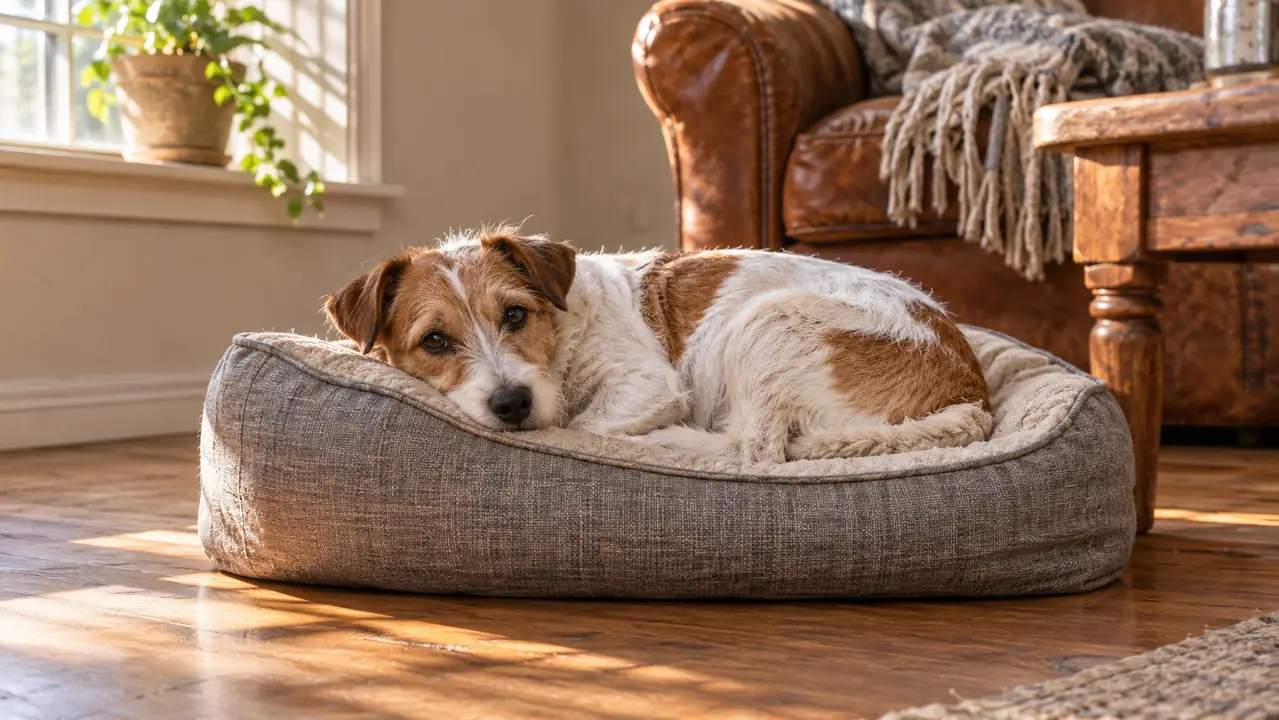
The bed went on the hardwood in the living room, about four feet from where I sit to read, and it has not moved since except to wash the cover. Pepper sleeps there at night and again after the morning walk. I kept her old flat bed in the bedroom for the first month because I did not want to force anything on her. She used both for about two weeks, then started choosing the Bedsure on her own. By the end of March the old one was in the garage.
Before I set it down I measured the spot where her old bed had sat, between the armchair and the bookcase, and checked the 23.62 by 17.72 inch footprint against it. It fit with about three inches to spare on the long side, which meant it was not going to get kicked around every time somebody walked past. I also flipped it over and looked at the bottom. Flat, no grip strips, nothing but fabric. That told me right away it was going to slide, and it did, the first time she jumped off it to bark at the mail truck.
I am methodical about this kind of thing, so I kept a note on the fridge. Not a spreadsheet, just a line each morning. Whether she came off the bed stiff. How long it took her to loosen up. Whether she took the steps down to the yard without stopping. Sixty-six years old and I still keep a service log. June says it is the only part of the old job I have not retired from.
One detail that matters for judging this bed: it sits directly on hardwood. No rug, no carpet pad, nothing under it. The only cushioning in the whole arrangement is the foam itself. That is a harder test than a bedroom floor with a rug on it, and it is closer to what most of these beds actually sit on.
What the Foam Actually Does
The listing says polyester and polyurethane foam, 3.44 pounds, roughly six inches tall at the bolsters. The foam is CertiPUR-US certified and the fabric carries an OEKO-TEX Standard 100 certificate with a number printed in the listing. For me that means somebody tested the foam for the heavy metals and the formaldehyde you would rather not have a dog breathing against for eight hours a night. I am not a chemist. But I have read a lot of spec sheets, and I know the difference between a manufacturer who publishes a certificate number and one who just writes the word premium and moves on.
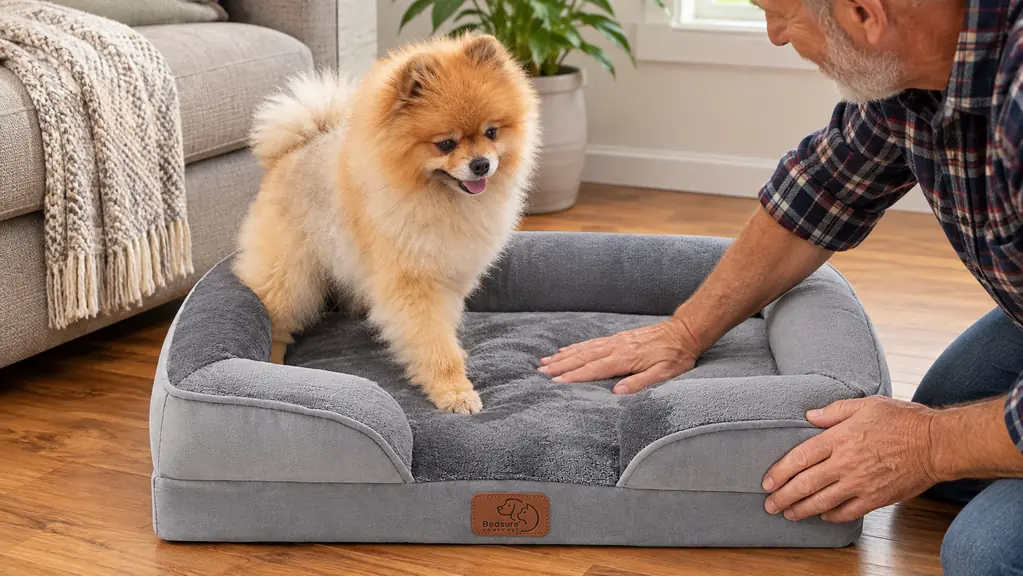
What I can actually report is how the foam behaved. A cheap bed flattens in the middle inside a month. You can feel the dip with your hand, a low spot right where the dog lies. I pressed the flat of my palm into the center of this one at week one, week six, week twelve, and week twenty-four. It has softened. It has not collapsed. There is still a good inch of resistance under my hand where Pepper's shoulder sits.
There was one morning in early May that told me more than the hand test did. We had a cold snap, forty-one degrees on the porch, and Pepper came off the bed stiff enough that she stood still for a count of ten before she walked anywhere. I put my hand where she had been lying and the foam came back up within a couple of seconds. On her old bed, that same spot would stay dented until noon. The bed is not why she was stiff. But it was not adding to it either, and for a dog with a long back that is about the most you can ask a piece of furniture to do.
That last part matters more for a Dachshund than for most dogs. A long back on short legs means the spine carries weight in a way it was never really designed to, and a bed that sags into a hammock puts the low point right under the belly. A flat, firm surface does the opposite. It spreads the load out instead of collecting it in one place.
The Bolster and the Ten Pound Number
The bed has bolsters on all four sides, higher than the sleeping surface, which gives Pepper something to press her back against. She is a nester. She circles three times before she lies down, every single night, and with the old flat bed she would circle and then stand there like she had lost her spot. With the bolsters she settles in about ten seconds.
Before I bought anything I tried the cheap version first, which is what I would suggest to anybody. I folded a quilt into a rectangle and set it in the same spot on the hardwood. Pepper used it for three days and then went back to the couch. The quilt slid apart into a heap by the second night, and there was nothing on the sides for her to press against. That experiment cost me nothing and it told me the bolsters were the part that mattered, not just the padding underneath.
Now the part I have to be straight with you about. The listing carries a maximum weight recommendation of ten pounds. Pepper is twelve. I knew that when I ordered and I ordered anyway, because twelve is not twenty, and because I wanted to find out whether the label was conservative or whether it was an actual limit.
Six months in, my honest read is that the label is roughly right and it is not a hard ceiling. The foam under Pepper's shoulder has held up fine. But I can see the start of a soft spot where her hip sits, and I would not put a fifteen pound dog on this thing. If your dog is nine or ten pounds, you are inside the design and you will probably get years out of it. If your dog is twelve or thirteen like mine, you will get good use and you should expect to replace it sooner than the people leaving five-star reviews with eight pound dogs.
The dimensions are 23.62 by 17.72 inches, and on the floor it looks smaller than the photos suggest. Pepper can stretch out along the length with a couple of inches to spare. She cannot stretch out on the diagonal. A dog that sprawls flat with the legs out straight will want more bed than this.
Washing It, Which Is the Part I Cared About Most
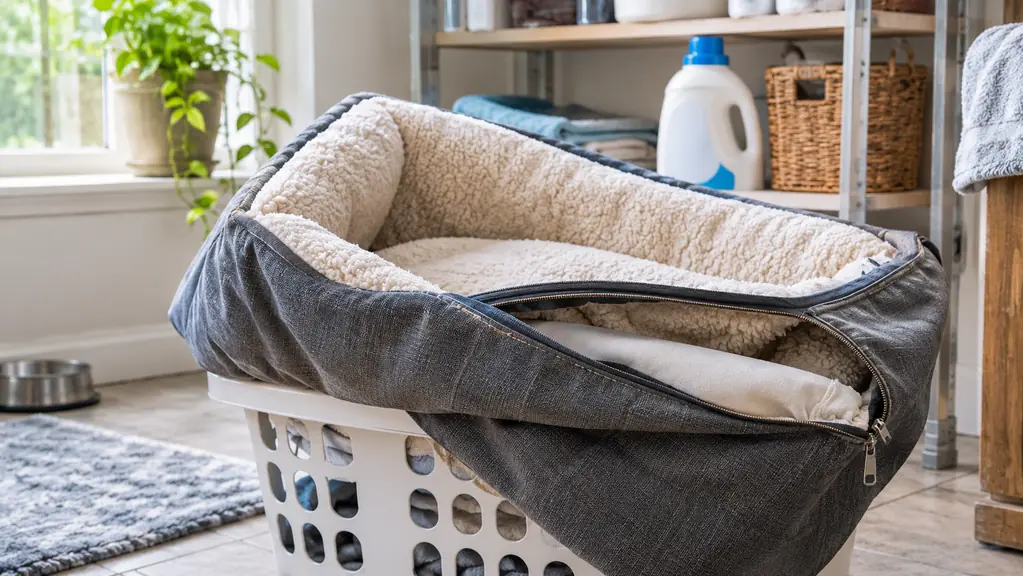
The cover comes off and the bed is listed as waterproof. I have washed that cover eleven times in six months, which is more than most people will, partly because Pepper has had two accidents and partly because a dog that spends Sunday afternoons on the floor with grandchildren gets a certain smell about it that I would rather not have in the living room.
A full wash runs about an hour of machine time and most of an afternoon of drying. I have settled into a routine: cover off Monday morning after the grandchildren go home Sunday, cold water, regular cycle, then hung over the back of a kitchen chair on the porch. In July it is dry by supper. In February it took until the next morning, and I would not want to be doing that the night before a car trip. It is not a complaint, just the fact of a fabric cover in Georgia humidity, and it is worth knowing before you pick your day.
The waterproof part is real in the sense that liquid does not go straight through to the foam. It pools on the surface long enough for you to get a paper towel on it. What it does not do is survive a puddle sitting overnight. One accident on a Saturday morning while we were at church worked through the seam where the zipper runs. The foam underneath took two days to dry by a window. If your dog has accidents regularly, a waterproof liner under the cover is worth the trouble.
The cover itself has been through the machine on cold, regular cycle, and hung over a chair to dry, and it has not pilled or shrunk. The zipper is adequate. It is not the heavy brass thing you would put on a work jacket. I expect to lose the zipper before I lose the foam.
What Changed With Pepper, and What Didn't
Here is where I have to be careful, because I do not want to sell you something that is not for sale. A bed is not medicine. Pepper still takes a few minutes to loosen up in the morning. She still hesitates at the top of the brick steps on cold days, and on the really cold mornings in January I carry her down rather than watch her work it out.
What changed is smaller and more specific. She stopped pacing the living room at night looking for a place to lie down. She used to try the couch, then the floor by the door, then back to the couch, and it wore me out just watching her. That stopped inside the first two weeks. She also started lying flat out on her side again instead of holding the curled-up position she had been stuck in, which I take as a sign that her back was not being asked to do anything extra.
The credit for the rest goes to our vet. We went in April. I told her what I had been seeing, she did an exam, and we came home with a plan that includes this bed, a joint supplement, and a shorter second walk once the afternoons get hot. If your dog is slowing down, get the diagnosis first. Everything after that is management, and a bed is one item on the list. It is not the top item.
One practical note. I have carried this bed out to the Buick twice for trips, and at 3.44 pounds it moves easily. It also slides on hardwood when a twelve pound dog launches off it at full speed. A strip of rug grip cut to size underneath fixed that.
What I Liked
- Foam softened over six months without collapsing under a twelve pound dog
- Cover unzips, washes cold, and has not pilled or shrunk through eleven cycles
- Four bolsters give a nester something to press against, and she settles in seconds now
- CertiPUR-US foam and OEKO-TEX Standard 100 fabric, both with certificate numbers in the listing
- 3.44 pounds, easy to carry from room to room or out to the car
- Waterproof surface holds a fresh accident long enough to blot it up
Where It Falls Short
- Listed for dogs up to ten pounds, and my twelve pound dog already shows a soft spot at the hip
- Waterproofing does not hold overnight, and it failed at the zipper seam
- 23.62 by 17.72 inches is snug for a dog that likes to sprawl
- Slides on bare hardwood when a dog pushes off it
- Zipper is adequate rather than heavy duty
I pressed my hand into the center of that bed at week one and again at week twenty-four. It has softened. It has not collapsed.
Who This Is For
This bed fits the owner of a small dog that weighs ten pounds or less and likes to sleep pressed against something. It fits a dog that circles before lying down and never seems satisfied on a flat surface. It fits a house with bare floors, because the bolsters keep a smaller dog from sliding off the edge when they push off to get up. And it fits anyone who wants to be able to pull a cover off and put it in the machine instead of throwing the whole bed out. If your dog is older, stiff in the morning, and already under a vet's care, this is a reasonable piece of the setup. If you want to go deeper on why a firm flat surface matters for a long-backed dog, I wrote about how the Bedsure foam compares to a memory foam bed, and there is a separate piece on ten reasons an orthopedic bed helps small dog joints.
Who Should Skip It
Skip it if your dog is meaningfully over ten pounds. I got away with it at twelve and I would not try it at fifteen. Skip it if your dog sprawls out flat rather than curling, because the footprint is small. Skip it if your dog cannot comfortably step over a bolster, which rules out some seniors with weak hind legs and some very small puppies. Skip it if your dog has frequent accidents overnight, because the waterproof layer buys you minutes, not hours. And skip it if you are hoping a bed will replace a vet visit. It will not, and I would rather tell you that than take the sale.
The number on the label is the thing to check first. If your dog fits under it, this bed earns its spot.
Six months on hardwood, eleven washes, one honest soft spot. Read the weight and dimension guidance on the listing and measure your dog against it before you decide.
Amazon Check Today's Price on Amazon →