

Pepper weighs twelve pounds. The Bedsure orthopedic bed for small dogs is rated for ten. That gap is the first thing nobody tells you, and it is the reason I left the box sitting in the garage for three days before I cut it open. I am sixty-six, retired out of the service department at a car dealership here in Marietta, and I spent thirty years deciding whether a part matched the number printed next to it. Two pounds is not nothing. But the bed measures 23.62 by 17.72 inches across and stands 5.91 inches tall, and Pepper is an eleven-year-old miniature Dachshund with a long back who has been stiff in the hips every morning since last winter. So I hauled the box out of the back of the Enclave, set the bed on the floor, and gave it six weeks before I made up my mind about anything.
What follows is the part a star rating cannot tell you. Bedsure has more than 36,000 ratings on this listing, and a number that size tells you the bed survives shipping and mostly satisfies people. It does not tell you whether the bolster is tall enough for a dog that likes to press his spine against something, whether the foam goes flat under a dog that is over the limit, or how the cover behaves after a wet week in Georgia. That is what I am here for. Nobody paid me, and I kept the packaging in case I had to send it back.
The Quick Verdict
A genuinely useful bed for a small dog that curls and needs something to brace against, held back only by a ten pound rating and a sleeping area that punishes a dog who likes to stretch out flat.
Amazon Check Today's Price →The bed I kept after six weeks and a two pound overage
It is not the bed for every small dog. It is very likely the bed for a curled-up sleeper with stiff hips. Check the size against your dog before you order, the way I should have.
Amazon Check Today's Price on Amazon →How I've Used It
The bed sits in the living room on the hardwood, between the couch and the brick wall, which is where Pepper already liked to lie. I did not move it into a corner or a crate. My thinking was that a new bed in a new place asks a dog to change two things at once, and at eleven, Pepper does not need two changes at the same time. June laughed at me for running a tape measure over the floor before I set it down. I measured anyway. The footprint is roughly two feet by a foot and a half, so it slides under the edge of the coffee table when the grandkids are over on Sunday, and it does not block the path from the kitchen to the front door.
I tried the cheap fix first, the way most people do. I folded an old quilt into a pad and laid it where the bed sits now, and Pepper used it twice and then went back to the bare floor. The quilt slid every time he stepped on it, and there was nothing on any side for him to push against when he got up. A stack of blankets is soft, but soft was not the part he needed. He needed an edge, and a blanket does not have one. That quilt is now in the back of the Enclave for hauling groceries.
The first night he walked a circle, stepped in, stepped out, and slept on the bare floor beside it. The second night he got in and stayed maybe twenty minutes. By the end of the first week he was in it most of the evening and I had stopped watching him like a hawk. That timetable is worth more than anything else in this review. If your dog is going to take to a bed, it usually happens inside ten days, and no bed at any price gets a suspicious older dog to love it on night one. If somebody tells you otherwise, they are selling something.
Morning is when I see the real difference. Pepper has always been slow off the floor, that first dozen steps stiff and careful, and it used to take him a good minute to loosen up before we headed out the front door for the first walk. After about three weeks on this bed, the stiffness was still there, but the time it took him to get up to speed was shorter. I want to be careful here. I cannot prove the bed did that, and neither can you, and our vet is the first to say that a soft place to sleep is one part of a bigger picture that includes weight, exercise and whatever else she has planned for him. But I know what I watched, and I watched it more mornings than not.
The Bolster Is the Part That Actually Matters
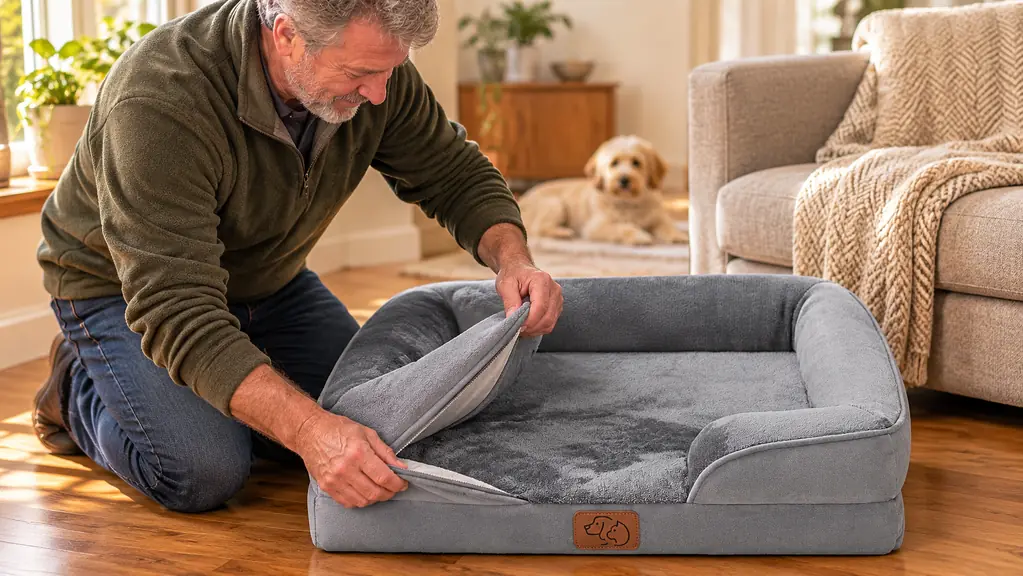
The bed is built like a shallow sofa. There is a flat sleeping pad in the middle and a raised edge running all the way around, which Bedsure calls a four-sided bolster. What that means in practice is that Pepper can press his back against one side and rest his chin over another, which is exactly how he slept on the couch before we stopped letting him jump up there. Dogs that like to curl want something to push against. Flat mats never worked for him, because there was nothing there to push against.
The rim stands 5.91 inches off the floor, which puts it right about at Pepper's chest when he is lying down. That number matters more than it sounds. Tall enough and a dog has to climb in. Too low and there is nothing worth leaning on. At his height he rests his chin over the near side and his back against the far side without either one looking like a struggle, and June noticed the chin thing before I did, which is usually how it goes in our house. I had been watching the back legs.
The bolster also gives him something to brace on when he gets up, and that sounds like a small thing until you watch an older dog try to rise off a slick floor. He plants his front feet on the pad, leans his shoulder into the side, and gets his back legs under him. On the bare hardwood he would slip and try again, sometimes twice. Here he does it in one motion most mornings, and one motion is a win at his age.
Where I would push back on the design is the depth of the middle. The center pad is thin enough that I can feel the floor when I press my palm flat on it, which is fine for a twelve pound dog and would be a fair complaint from someone with a heavy spaniel. Bedsure is not hiding this. The listing says ten pounds, plainly. I am simply telling you that the ten is real and it is not conservative. This is a bed for a dog that needs a soft place and a wall to lean on, not a bed for a dog that needs a thick slab of foam under a lot of weight.
The Ten Pound Rating, Explained Honestly
Here is the thing that does not make it into the product photos. The maximum weight recommendation on this bed is ten pounds. Pepper is twelve. I am over the line by about twenty percent, and I have watched for the consequences for six weeks. What I see is a center pad that compresses about as far as it did in week one, no sagging at the corners, and no sign that the foam has taken a set where he turns around before he lies down.
If your dog is fifteen pounds and shaped like a loaf of bread, this is not the bed. Not because it would collapse overnight, but because the sleeping area is genuinely small. 23.62 by 17.72 inches is a bed for a dog that curls. A dog that stretches out flat will hang over the bolsters, and a dog that hangs over gets no support from them at all. Measured nose to tail base, Pepper is right at the limit of what fits inside the pad, and he sleeps curled most of the night, which is the only reason it works as well as it does.
I would tell anybody to do that measurement before ordering rather than after. Put the dog on the floor, mark where the nose and the base of the tail land, and compare that to two feet by eighteen inches. If the number comes out close, order it. If it comes out long, look at a bigger size and accept that you are giving up floor space in the room where you watch television. That is the whole trade.
What Six Weeks of Daily Use Did to the Foam
The core is polyurethane foam, and the cover is polyester. Bedsure says the foam is CertiPUR-US certified and the fabric carries an OEKO-TEX Standard 100 certification, listed as 24.HCN.46956. I am not a chemist and I am not going to pretend to be one. What I can tell you is that a certification is a claim about what is not in the foam, and for a bed that sits in the room where I watch the evening news, I would rather have the paperwork than not have it.
Six weeks in, the pad has not gone flat. I check it the way I used to check tire wear, pressing the same four spots once a week with the flat of my hand. There is a slight softening where he turns around before he settles, maybe a quarter inch, and nothing beyond that. The cover has not pilled in the middle or at the seam where he scratches at it before he lies down.
Sundays are when I look closer, because that is the quiet hour before the grandchildren come through the door. I take the cover off, set the foam on the coffee table, and lay a straightedge across the top from corner to corner. In week one there was no gap under it anywhere. By week six there is a shallow dip where he turns, and I can slide a fingernail under the straightedge at that one spot. A quarter inch, maybe a little less. The four corners have not moved at all, and the whole bed still weighs what it did out of the box, right around three and a half pounds.
The honest weakness is the sides. The bolsters hold their shape because of the foam inside them, and if Pepper stands on an edge instead of leaning on it, the side gives and stays given for a few minutes. It comes back. It does not come back perfectly every single time. A dog that likes to stand on the rim of his bed will flatten this one faster than a dog that just lies in it, and I would guess that is where most of the three star reviews come from.
By week three he was getting up off the floor in one motion instead of two, and that is the whole review in one sentence.

The Washing Question
The cover comes off, and the bed is listed as washable, waterproof and easy to clean. Pepper had one accident in week four, the kind that happens when a dog gets up too slowly in the morning. It beaded on the surface. I blotted it, wiped it with a damp cloth and a little mild soap, and it did not soak down into the foam or leave a smell behind. That is the test I actually care about, more than whether it survives a machine cycle, because the accident is the thing that happens at six in the morning when you are still in your robe.
I have washed the cover once, on its own, and let it air dry over the porch rail on a Saturday afternoon. It went back on without a fight and did not shrink enough for me to notice. What I would tell you is that the cover is the part that wears, not the foam, so treat the cover as the piece that decides how long this bed looks presentable in your living room. Two dogs and daily traffic would shorten that window. One twelve pound Dachshund and a single accident in six weeks will not.
What I Liked
- The four-sided bolster gives an older dog something to brace against when he stands up
- The center pad has held its shape for six weeks under a dog two pounds over the rated limit
- Liquid beaded on the surface instead of soaking into the foam
- Small footprint slides under a coffee table and stays out of the walking path
- CertiPUR-US foam and OEKO-TEX certified fabric, both named on the listing
Where It Falls Short
- Rated for ten pounds, which is a real limit and not a cautious one
- The sleeping area suits a dog that curls, not a dog that stretches out flat
- The bolster sides flatten for a while if a dog stands on them
- The center pad is thin enough that a heavier dog would feel the floor through it
Who This Is For
This bed is for the owner of a small dog that curls up tight and likes to sleep pressed against something. It is for a dog that has started hesitating at the couch or the back steps, the way Pepper did, and for a house with hard floors where getting up in the morning takes a while. It suits somebody who wants a bed in one room and is not planning to drag it from the bedroom to the kitchen every day. It also suits an owner who would rather wash a cover than replace a whole bed, because that is the part that will wear out first. If that describes your house, this is a sensible buy and I would make it again.
Pepper and I walk twice a day, morning and evening, and the evening one is shorter than it used to be. The bed is where he goes when we come back in, before he has his water, and he stays there while I get my boots off at the door. That is the routine I was trying to protect when I started looking at beds in the first place, and it is the reason I did not send this one back over two pounds. If your dog has a spot in the day that has gotten harder than it used to be, you already know what I mean.
Who Should Skip It
Skip it if your dog is over about twelve pounds, or if he sleeps stretched out with his legs in front of him, because the bolsters stop being support and start being an obstacle. Skip it if your dog stands on the rim of his bed, since the sides will give and you will spend your evenings pushing them back up. Skip it if you have a chewer, because this has a foam core under a fabric cover and a determined chewer will find it. And skip it if you are looking for a diagnosis. A bed is a comfort measure, not a treatment. Pepper's hips were checked by our vet before I bought anything, and I would not skip that step for the world.
Measure your dog first, then decide
Two feet by eighteen inches is the whole test. If your dog fits that curled up, this bed has earned its place in my living room. If he does not, save the return shipping and look at the larger size.
Amazon Check Today's Price on Amazon →