
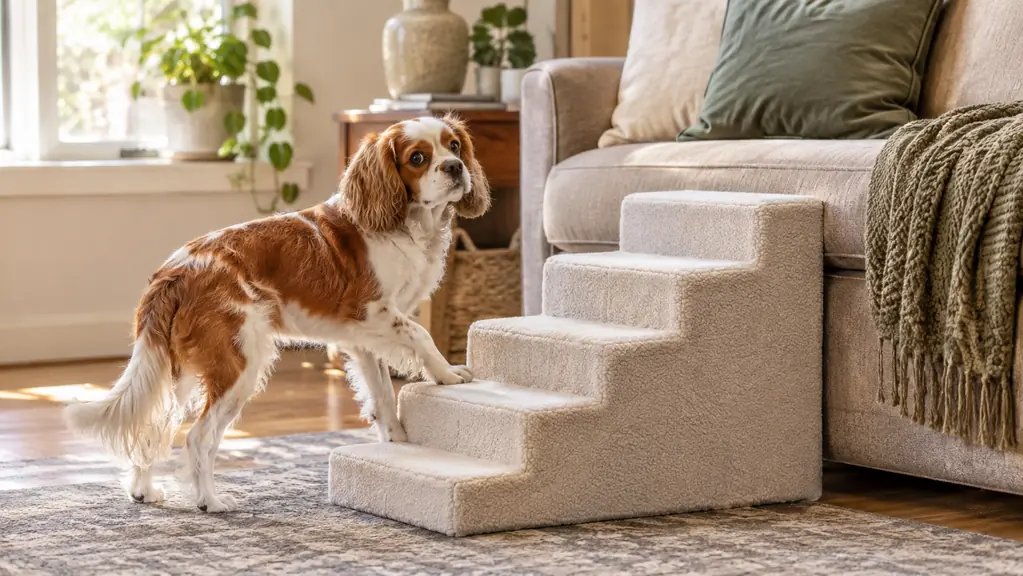
Pepper stopped at the top of the back steps in February and just stood there. Eleven years old, twelve pounds, a miniature Dachshund with a long back and hips that had gone stiff in the mornings. For about a week I had been lifting her down those three brick steps into the yard and lifting her back up again, and my lower back had started filing complaints. So I did what I always do when something in my house is not behaving the way it should. I read everything I could find, ordered a set of aodisman dog steps, and gave them two full months before I decided whether they were staying.
This is not a review written from a photograph. I am 66, retired off the service desk at a car dealership in Marietta, Georgia, and I spent my working life watching how a thing behaves over weeks before I trusted it. A transmission that feels fine on the test drive can be a different animal at 40,000 miles. Same with a set of pet stairs. What follows is what eight weeks of twice-daily use actually did, what it solved for Pepper, and the handful of things that still get on my nerves.
The Quick Verdict
Light enough to move with one hand, no assembly, and steady enough that Pepper climbs without hesitating. Not a fix for a dog that cannot bear weight, and not something to trust on slick hardwood without checking it.
Amazon Check Today's Price →The steps Pepper climbs eight times an evening without a pause
Four foam steps, 5.8 pounds, no assembly, ready in a day or two. Measure your couch height against the 17.4 inch top step before you order.
Amazon Check Today's Price on Amazon →How I've Used It
The steps live against the front of the couch in the den. That is where Pepper wants to be in the evening, and it is where she used to launch herself off the cushion and land like a dropped sack of flour. I set them down the day they arrived and I have not moved them since, apart from sliding them out to vacuum underneath. She goes up and down maybe six or eight times on an evening, and again in the morning when she follows me to the kitchen.
Eight weeks is long enough for novelty to wear off, which is the part I wanted to see. A dog will try anything once. What I wanted to know was whether she would still use them in April, and whether she would use them when she was tired or sore or in a hurry. She does. The only time she skips them is when June is already on the couch and Pepper decides the direct route is faster, which tells you something about a Dachshund's opinion of stairs in general.
The footprint is 26 inches deep by 15.7 inches wide, and the top step lands at 17.4 inches high. That last number is the one that matters, so measure your couch before you order anything. My seat cushion sits at about 18 inches, which is close enough that the top step reads as part of the couch instead of a separate object she has to commit to. If your couch is a deep low-slung thing at 14 inches, four steps is more stair than you need and the top one will stand proud of the cushion like a little tower.
What These Steps Are Actually Made Of
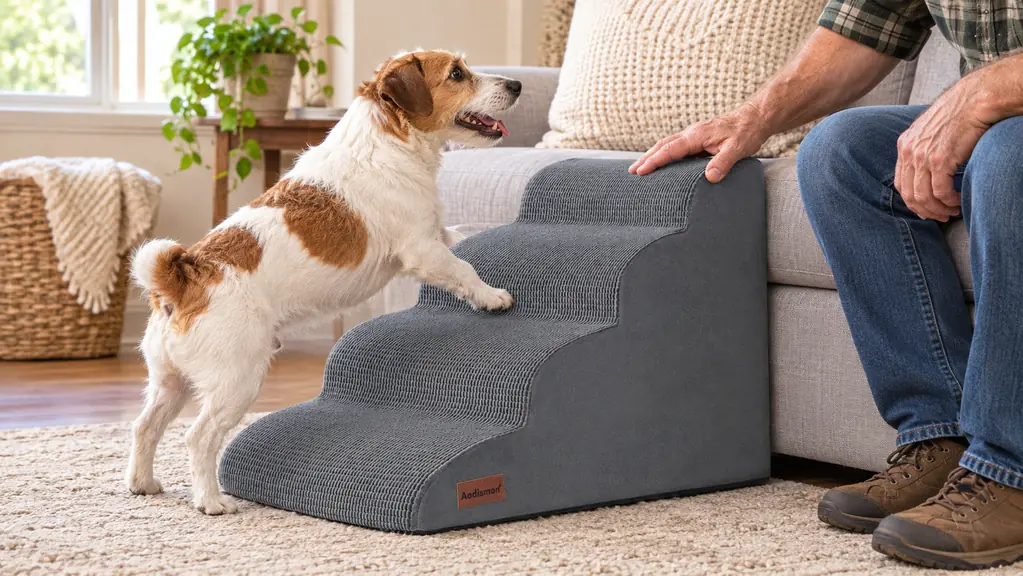
The aodisman set is four foam layers wrapped in a durable, friction-resistant fabric with a non-slip bottom, 5.8 pounds on my scale. There is no frame, no hinge, no screws, no tools and nothing to assemble. It arrives compressed. You cut the wrapping and let it sit, and over the next 24 to 48 hours it expands into the stair shape you see in the pictures. Mine was fully formed by the second evening. The corners were still a little soft on day one, so I did not put a nervous dog on it that first night.
Foam instead of a folding frame is the whole design decision, and it cuts both ways. The upside is that there is nothing to pinch a toe, nothing to collapse if a dog lands on it wrong, and it weighs so little that I move it one-handed. The downside is that foam is not furniture. It is not a step stool. If you have a 60 pound dog, or a grandchild who thinks it looks like a slide, this is not the product for that house.
The non-slip bottom is honest on carpet. On the hardwood in my living room it is better than the towel-covered box I was using before, but it is not fixed down, and a dog that launches at the top step will push the whole thing an inch or two over a week. I checked it every couple of days for the first month, which takes about four seconds, and it has not wandered since. There is a one year warranty and I have not had to test it.
The First Two Weeks, Day by Day
The first day I set them down and put a piece of kibble on the second step. She took the bait, ate it, and backed off. The second day she put one paw on. The third day she went up all four and stood at the top looking at me like she had done something clever, which she had. That is about the pace I expected, and I did not push it, because a dog that gets spooked off a set of stairs at eleven years old does not come back to them quickly.
Going down took four days longer than going up, which is normal in my experience. Down is the direction where a dog has to trust the surface. What got her over it was me sitting on the floor at the bottom with my hand flat on the third step so she could see where her front feet were heading. By the end of the second week she was doing it without me. Now she does it in a hurry, which is its own small worry, but she has not missed a step.
The change I actually notice is in the mornings. Pepper has always been stiff when she first gets up, and she used to stand at the edge of the couch for a good ten seconds working out whether the landing was worth it. Now she just goes. Our vet is the one who explained why that matters, and I will pass it along the way he said it to me: a small dog that hesitates at a height and jumps anyway is taking the landing on the front legs, and the front legs are attached to the same sore back. He was clear that this is management, not treatment. If your dog is showing real pain, get a diagnosis before you buy anything.
One thing I did not expect: she started using them to get off the couch backwards, tail first, one step at a time. I have never seen her do that on anything else. It is slower and it looks ridiculous, but it tells me she trusts where her back feet are landing, which is the whole point of the exercise as far as I am concerned.
Where They Work and Where They Do Not
Against the couch, they work. Against the bed, they work, provided your mattress height is in the same neighborhood as the 17.4 inches these reach. Where they do not work is my back steps. Those are three brick steps down to a concrete landing, and there is nowhere to seat a foam stair against them that would not shift in the rain. For the yard I ended up carrying Pepper down and letting her walk up on her own, and that is a compromise I have made peace with.
One more thing about placement. The listing says to put them right up against the edge of the bed or couch, and that is not a suggestion, it is the whole trick. A gap of two inches between the top step and the cushion is a gap the dog has to think about, and thinking about it is how you end up with a dog that goes back to jumping. Mine sit flush. I shoved them in tight the first day and they have stayed tight.
On the bed question, be honest with the tape measure before you get your hopes up. A standard mattress on a standard frame runs taller than most couches, and if your bed sits at 24 inches these four steps will get a dog two thirds of the way there and leave her looking at a lip she still has to clear. Ours is a low bed and it works fine. If yours is a tall one, I would look at a five or six step set instead of trying to make this one do a job it was not built for.

The Things That Still Bother Me
The fabric collects dog hair. Not badly, but a Dachshund sheds and this surface holds it. I keep a rubber glove in the drawer and wipe the steps down on Saturdays, which takes about a minute, and muddy paws have come off with a damp rag without staining. What I cannot tell you is how it holds up to a chewer, because Pepper does not chew, and the fabric is soft enough that I would not bet on it against a determined puppy.
Second, this is a piece of foam furniture in your living room. It is not an ugly object, but it is an object, and in a house where things are supposed to match you will notice it. The top step also compresses slightly under a foot, so a dog standing right at the edge will feel it give. Pepper does not care. I noticed it in week one and I still notice it now, so I am telling you. And one word problem: the title calls these stairs and a ramp in the same breath. They are stairs. Four distinct levels a dog steps up one at a time. If you pictured a long inclined plane, that is not what arrives.
Third, and this one matters in my house. Our grandchildren come by on Sundays after church, and the youngest is three. A four-step foam stair is exactly the right height to look like a toy and exactly the wrong thing to have in the path between the kitchen and the television. For those few hours the steps come off the floor and go behind the couch, which takes one hand and about two seconds. That is not a knock on the product, it is just what an honest owner does with it.
What I Tried Before This
Before I bought anything I tried the free options, partly because I am tight with a dollar and partly because I wanted to know whether the height was really the problem. I stacked two cushions by the couch. Pepper walked around them. I built a step out of a sturdy box with a towel over it, which worked for about a week until the towel slid, she lost her footing once, and would not go near it again. I also looked hard at the wooden folding stairs a neighbor has. I passed because they weigh a good deal more and they have hinges, and hinges plus a twelve pound dog on a hardwood floor is a combination I did not want to test.
The other question everybody asks is stairs against a ramp, and my short answer after living with both ideas is that a ramp takes up more floor space while a stair takes less. In a small den, less wins. A ramp is the better tool if your dog will not lift a foot at all, but a dog that can still climb will usually climb a stair she can see the top of.
What I Liked
- 5.8 pounds, so it moves with one hand when I vacuum
- Arrives compressed and needs no assembly, usable in 24 to 48 hours
- Four foam steps reach 17.4 inches, which meets most couch seats
- Non-slip bottom holds on carpet and stays put when pushed flush
- Nothing to pinch, nothing to collapse, no hinge to fail
- One year warranty
Where It Falls Short
- The fabric collects dog hair and needs a weekly wipe
- The top step compresses a little under a foot
- Foam, not furniture. Not for big dogs and not for kids
- It will creep on slick hardwood over time
- No use outdoors on brick or uneven ground
The change I actually notice is the mornings. She used to stand at the edge of the couch for ten seconds working out whether the landing was worth it. Now she just goes.
Who This Is For
If you have a dog under about 25 pounds that is hesitating at the couch or the bed, and your seat height is somewhere near 17 or 18 inches, these are a sensible buy. They suit a one-story house with carpet or a rug, an owner who wants something they can pick up with two fingers, and a dog that will follow a piece of food onto a new object. The aodisman steps have come through eight weeks of twice-daily use with no visible breakdown, and I have looked at the seams more than once.
They also suit the owner more than the dog, if I am being honest. I am 66 with a back that has spent forty years leaning over engine bays. Lifting twelve pounds down three steps twice a day does not sound like much until you have done it for a month. That stopped the day these landed.
And they suit a household that wants the honest version of this purchase. Nothing here is a cure. It is a set of stairs, low to the ground and light enough to move, that lets an older small dog get up and down without a landing. That is all it claims to be, and it does that job.
Who Should Skip It
Skip these if your dog is over about 30 pounds. The foam is not built for it and 15.7 inches of width will feel narrow to a bigger animal. Skip them if your dog is showing real pain, dragging a leg or refusing to bear weight, because stairs are not a treatment and you need a diagnosis first. Same if your floors are polished hardwood and your dog hits the top step at speed, or if you have a puppy that chews, or if what you actually need is to bridge a set of outdoor steps where a foam block will sit in the weather.
And skip them if what you wanted was a ramp. The title uses both words. Four steps is what shows up. The aodisman steps are honest about what they are, and it is worth being honest with yourself about whether that matches the job in your living room before you spend the money.
Eight weeks in, they are still sitting against my couch
Four foam steps, 5.8 pounds, no assembly, ready in a day or two. Measure your couch height first, then decide.
Amazon Check Today's Price on Amazon →