
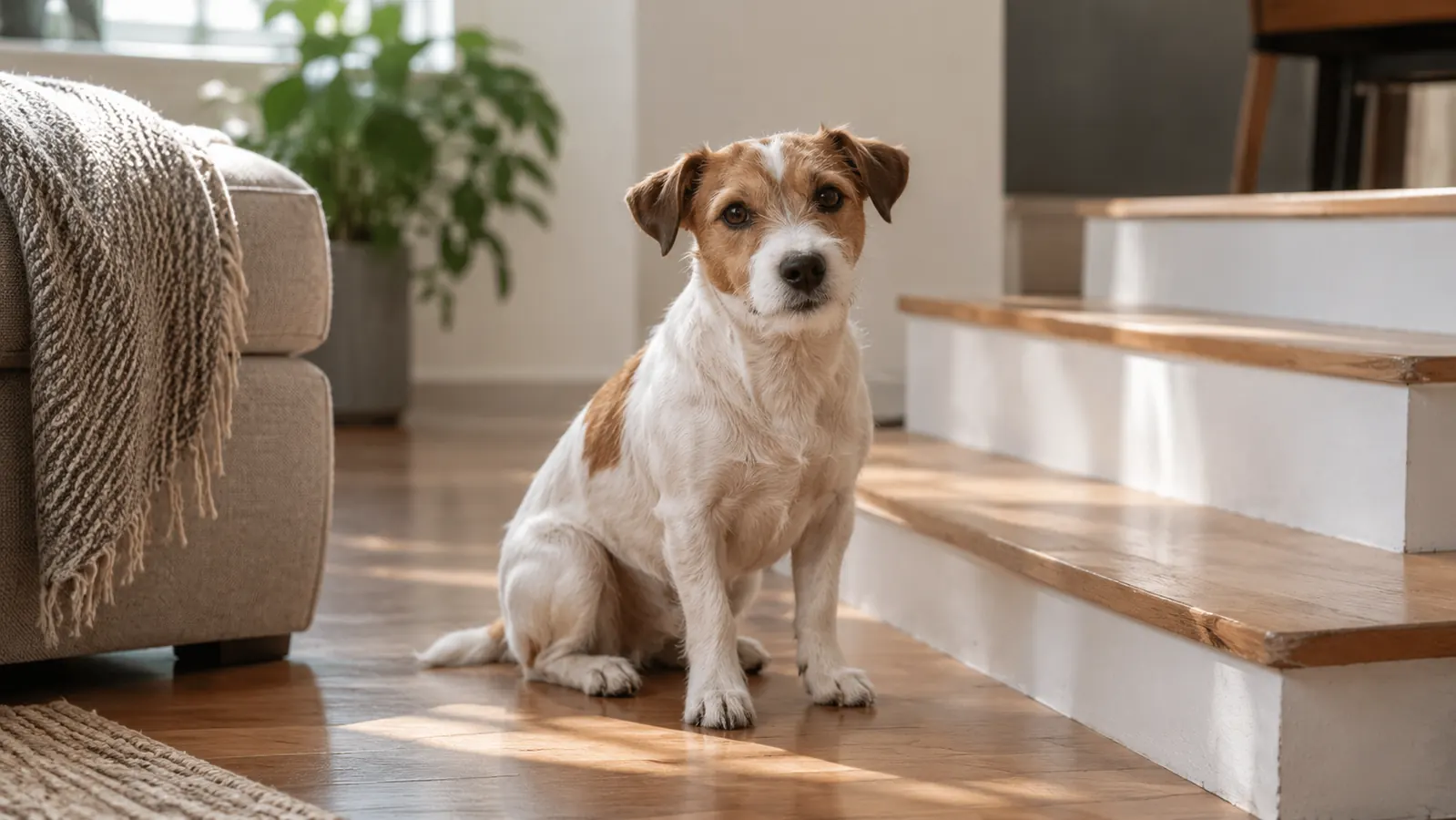
Pepper is an 11-year-old miniature Dachshund, about 12 pounds, and she started stopping at the three brick steps to the backyard in January. Not every time. Just enough that I noticed. I retired from the service department at a car dealership, so I tend to watch a problem for a while before I touch it. I watched her for two weeks. Then I put a folding ramp beside the couch and a set of the aodisman four-step pet stairs beside the bed. That is the short version of this comparison.
For most small dogs with aging joints, the aodisman steps are the easier first purchase. They come pre-assembled, they sit against a bed or couch, and a 12-pound dog can take them one step at a time. A ramp is the better choice in one clear case: your dog already trusts an incline and you have enough floor space to make that incline gentle. A short ramp on a tall couch is not gentle. It is a slide with carpet on it.
| aodisman 4-Step Pet Stairs | Folding Dog Ramp | |
|---|---|---|
| Setup | Ships pre-assembled. I set it down and it was ready. | Folds open, but some ramps need a strap or a lean against the furniture. |
| Footprint | 26 inches deep, 15.7 inches wide, 17.4 inches high. | Usually needs a longer clear run to keep the angle gentle. |
| Learning curve | Four separate steps give a small dog a place to pause. | One continuous incline can make a nervous dog rush or refuse. |
| Joint impact | Four short rises, each one a small lift. | No step edges. A shallow ramp is smoother for a dog that already trusts one. |
| Stability | Non-slip bottom and friction-resistant fabric on a foam body. | A rigid ramp with side rails can feel more solid to a nervous dog. |
| Cleaning | Polyester surface, wipe with a damp cloth. | Hard plastic or wood wipes clean. |
| Bed and couch | Built to sit against a bed or couch edge. | Works at a couch, but the run can crowd a bedroom. |
| Vehicle use | Not the tool for a tailgate or SUV load height. | A folding ramp is the usual choice for a vehicle. |
| Warranty | 1 year. | Varies by maker. |
| Best for | A small dog that needs a low, repeatable route to bed or couch. | A confident dog with a long, gentle runway. |
Where aodisman Wins
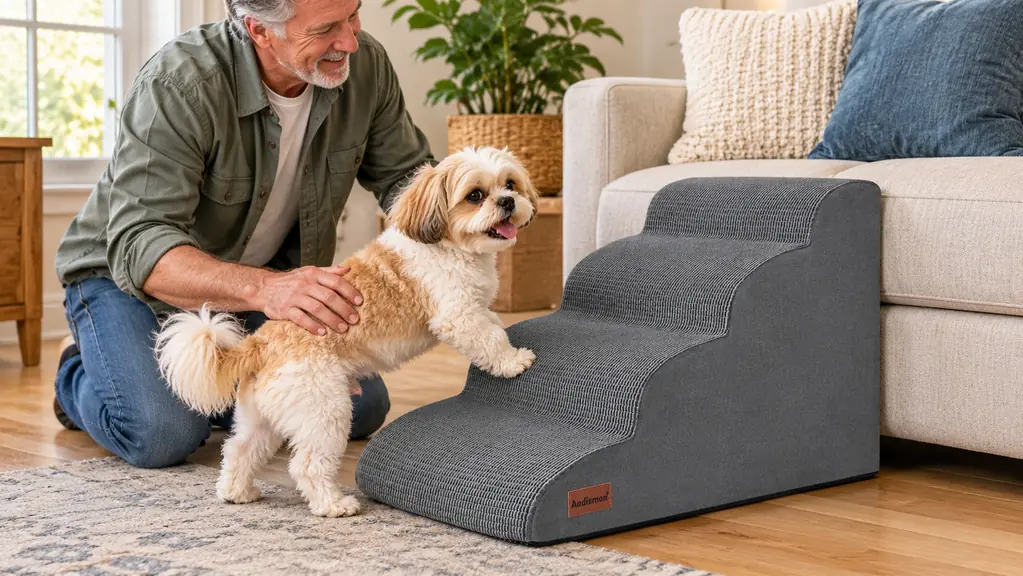
Setup is the first place. The aodisman unit arrived as one piece. The listing says no assembly required, and that matched what I found. It weighs 5.8 pounds, so I carried it from the bedroom to the living room with one hand while I was still in my slippers. The footprint is 26 inches deep by 15.7 inches wide by 17.4 inches high. It sat against the couch edge without me moving the end table. A ramp in the same spot would have needed a longer run, and the run is what eats a small living room.
The second place is how a small dog learns it. Pepper is long in the back and stiff in the hips in the morning. She does not like to commit to one big motion before she has tested the surface. Four separate steps let her stop on step two, look at the couch, and then decide. The bottom is non-slip and the walking surface is a friction-resistant fabric over foam, so her nails did not skid when she came down. I am not going to call a set of stairs a medical device. I am telling you what I saw: she used it on the second day without me standing over her.
Where the Ramp Wins
A ramp is gentler on paper because there are no step edges at all. For a dog with a long back and a tender hip, a shallow incline lets the dog walk instead of lift. That matters. If your dog is already comfortable on a ramp, and you can give up the floor space to keep the angle low, the ramp is the smoother route. I would not argue with that. The catch is the word shallow. A ramp that is too short for the height is steeper than stairs, and a steep ramp is harder on a small dog than four short rises.
A rigid ramp with side rails also feels more solid under a nervous dog. The aodisman steps are foam, and foam has a little give. Pepper did not mind that. A dog that startles at movement might. A hard plastic or wood ramp also wipes clean in one pass, while the polyester surface on the steps takes a damp cloth and a little patience. And for the 2015 Buick Enclave, a folding ramp is the right tool. The aodisman steps are listed for a bed or couch. I am not going to pretend they are a tailgate ramp.
If the couch is the obstacle, start with the route Pepper uses
The aodisman steps come pre-assembled and sit against a bed or couch. For a 12-pound dog that needs a low, repeatable path, this is where I would start.
Amazon See the aodisman Steps on Amazon →The Angle Problem Nobody Mentions
Here is the part I wish more ramp listings put in plain type. A ramp is only as gentle as its length. To get from the floor to a couch seat, the ramp needs a long run. If the run is short, the angle is steep. If the angle is steep, your dog is not walking a gentle slope. Your dog is trying to keep her feet under her on a hill. Measure the height from the floor to the couch seat. Then measure how much floor you can give up. If the second number is small, steps are the more honest answer.
I measured our couch at home and I measured the space between the couch and the coffee table. That space is why the ramp went back to the garage. The aodisman steps fit in the same footprint as an end table. The ramp did not. This is not a knock on ramps as a category. It is a knock on buying a ramp without measuring. A ramp that crowds the room gets moved, and a ramp that gets moved gets used less. A tool you do not use does not help a dog.
A ramp is only gentler if the angle is gentle. A short ramp on a tall couch is a slide with carpet on it.
What I Watched With Pepper
I put the aodisman steps at the bed first. Pepper looked at them, walked around them, and went back to her rug. That is normal. I put a piece of her kibble on the first step and left the room. By the end of the week she was going up on her own and waiting at the top for me to say good girl. The down trip was the part I watched closest. She came down one step at a time, not in a jump. That was the whole point. The jump down from the couch was the thing I wanted to stop.
I still watch her in the morning. Some days she is stiffer than others. On the stiff days she takes the first step slower, and I let her. Our vet is the one who told me to keep her moving and to stop the repeated jumps down from furniture. I am not diagnosing your dog. I am telling you what our vet told me. If your dog yelps, drags a foot, or refuses to put weight on a leg, this is not a stairs problem. Call your vet. A set of steps is a help around the house, not a treatment.
How to Measure Before You Choose
Measure the height from the floor to the surface your dog wants to reach. The aodisman unit is 17.4 inches tall. Check that against your couch or bed before you order. Then measure the floor space in front of that surface. The steps take 26 inches of depth and 15.7 inches of width. A ramp will take more depth if you want a low angle. Write both numbers down. Then watch your dog for a week. Does she hesitate at one step? Does she bunny hop up the couch? Does she pick the same route every time? The answers tell you more than a product page.
If your dog is already using a board or a low incline without fear, a ramp may be the better fit. If your dog stops at the first step and looks back at you, start with steps. If your dog is very long in the back, talk to your vet about the angle before you buy either one. A shallow ramp can be the kinder choice. A steep ramp is not. The same rule applies to steps: low rises are better than high ones. The aodisman unit has four layers, which breaks the height into smaller pieces. That is the reason it worked for Pepper.
What About a Long-Backed Dog?
A miniature Dachshund is a special case because the back is long and the legs are short. A ramp sounds like the obvious answer, and sometimes it is. But the ramp has to be long enough to keep the spine from curling into a steep climb. A short ramp can make a long-backed dog bunch up. The aodisman steps ask for four short lifts instead of one long climb. I am not a vet, and I am not going to pretend to be one. Our vet told me the goal was to stop the jump down and keep Pepper walking. The steps did that in our house.
If your dog has a diagnosed back issue, the decision belongs to your vet. A ramp may be the better recommendation. A step unit may be fine. The point is not to buy either one and hope. Ask. Then measure your furniture. Then watch your dog use it for a week while you keep a hand nearby. A dog with a sore back will tell you pretty fast if the route is too much.
What I Would Do First
If I were starting over with Pepper, I would do three things in this order. I would measure the couch and the floor space. I would borrow or test a ramp for a day if I could. Then I would buy the aodisman steps if the floor space was tight and the dog was hesitant. That order saved me from buying a ramp that did not fit. It also kept Pepper from practicing a steep climb that she did not need to practice.
I would also put the steps where the dog already wants to go. Do not put them in a spare room and expect the dog to seek them out. Put them at the couch your dog already jumps on, or the bed she already jumps off. Then put a treat on the first step and walk away. Let the dog choose. That is how Pepper learned it. No pushing, no lifting, no standing over her. A dog that chooses the route is a dog that keeps using it.
Who Should Buy Which
Buy the aodisman steps if you have a small dog, a bed or couch, and a tight floor plan. Buy them if your dog needs a repeatable route with places to pause. Buy them if you want something that comes out of the box ready and weighs less than a gallon of milk. Buy a ramp if your dog already trusts an incline, if you have a long run of floor to keep the angle low, or if you need to load a dog into a vehicle. Buy a ramp if a hard surface is easier for you to keep clean. There is no single right answer for every house. There is a right answer for your house, and it starts with measurements.
I am not going to tell you the aodisman steps are the only answer. They are the answer that worked in my one-story brick ranch, with a 12-pound Dachshund who needed to stop jumping down from the couch. If your dog is larger, or if your couch sits higher than the steps reach, a ramp or a different step height may be the better fit. If your dog is recovering from surgery, ask your vet before you change anything. That is not a disclaimer. It is the same advice I would give you over the fence.
The best route is the one your dog will actually use
For Pepper, that was the aodisman four-step set against the couch. Measure your furniture, watch your dog for a week, and ask your vet before you change a routine around joint pain.
Amazon View the aodisman Steps on Amazon →