
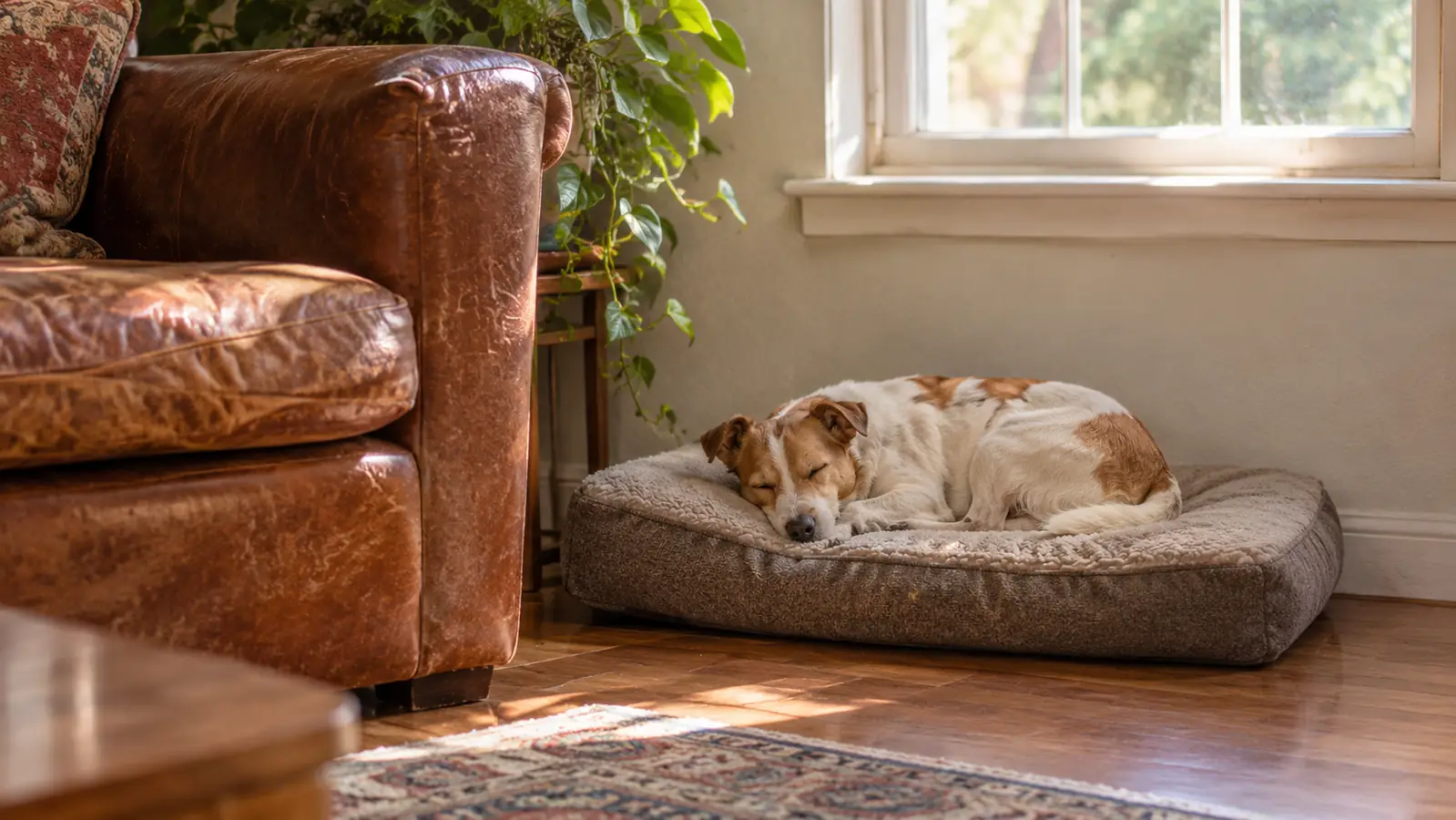
I noticed it at the back steps first. Pepper would get to the top, put one front paw out over the brick, then pull it back like the step had turned to ice. She is eleven years old, about twelve pounds, a miniature Dachshund with a long back and hips that had gone stiff in the mornings. For three weeks I told myself she was just being careful. Then our vet took an X-ray and used the word arthritis, and I stopped telling myself anything.
What I did next is what I always do, which is buy four of something before I understand one of them. A bed is not a treatment. It will not reverse a joint or buy back cartilage, and I want to be clear about that before I say another word. What a bed can do is take a dog's weight and spread it across a surface that gives instead of fights back, so the hip and the shoulder are not grinding into a flat slab for nine hours a night. The Bedsure orthopedic bed for small dogs is the one that ended up staying in our living room. What follows is how I would sort through the rest of them now, if I were starting over with what I know today.
The one that stayed in our living room
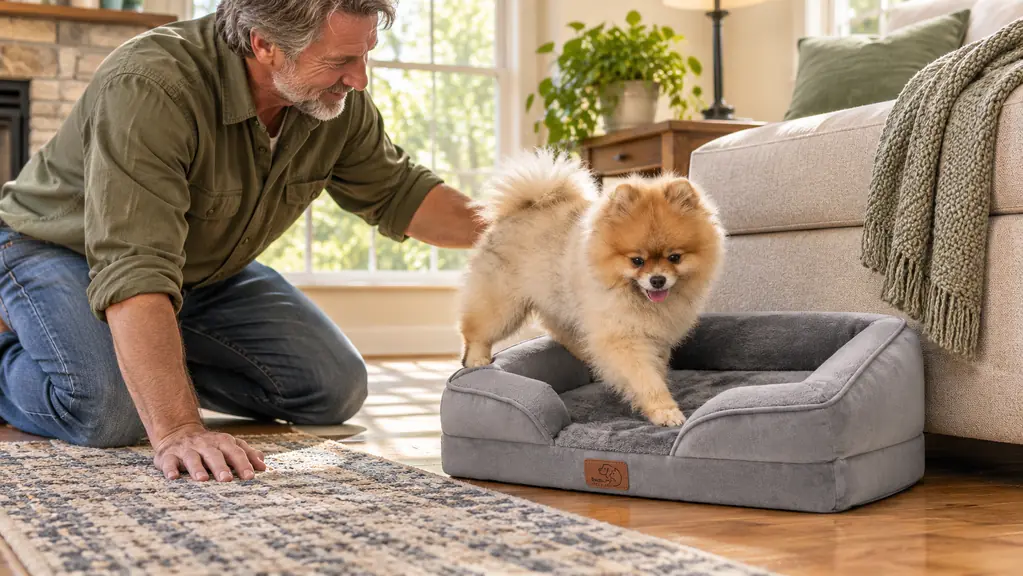
Rectangular, four-sided bolster, removable cover, foam core. 23.62 by 17.72 by 5.91 inches, 3.44 pounds.
Amazon Check Today's Price on Amazon →Step 1: Get a Diagnosis Before You Shop
Before I bought anything I took Pepper in. Our vet did what I should have expected. He lifted her, ran his hands down her back, watched her walk across the tile, and took an X-ray. What came back was arthritis in both hips, mild, plus the beginning of a disc issue that a Dachshund's build invites. He gave me two sentences that changed how I shopped. Keep her lean. Keep her off the furniture she has to jump onto.
The reason this comes before shopping is that the wrong bed is not neutral. It is worse than a folded blanket on the floor. A bed that is too soft lets a sore hip sink into a hollow, and getting out of that hollow first thing in the morning is the hardest thing your dog will do all day. A bed that is too firm is a floor with fabric stapled to it, and a dog with elbow calluses gets nothing from it. Back problems usually want firm. Hip and elbow problems usually want give. Those are not the same bed, so ask which one you are dealing with.
One more thing from that visit, and it is the most useful thing I carried into every product page afterward. He asked how much Pepper weighed, I said twelve pounds, and he wrote it down. Every bed listing you will look at has a weight recommendation on it. Knowing your dog's real number, not the number you remember from two years ago, is what tells you whether the listing is even talking to you.
Step 2: Measure the Dog, Not the Bed
The Bedsure bed is listed at 23.62 by 17.72 by 5.91 inches and 3.44 pounds, rectangular, with a maximum weight recommendation of 10 pounds. Pepper is about 12. I am telling you that up front, because it is the kind of thing you find out after the box arrives otherwise. She is a little over the listed weight and the bed has held up fine for her. If your dog is closer to 15 or 20 pounds, though, stop reading reviews of this one and go find the next size up.
Measure the dog, not the bed. Get a tape and run it from the base of the tail to the front of the chest while the dog is lying down and stretched out, then add a couple of inches. A bed that only fits the curled-up position is a bed the dog slides off of when it tries to straighten a stiff leg at two in the morning. You will find that out the hard way if you shop by the picture instead of the tape.
The height matters as much as the footprint, and nobody puts it in the headline. This one is 5.91 inches tall overall, and that number includes the bolster around the edge. For a dog already hesitating at a brick step, a wall of fabric it has to climb over is a reason to sleep on the floor instead. Watch your dog get onto the couch. If it takes a small hop with the front feet, you want something it can walk straight onto. If it launches itself, you have more room to work with.
One practical note on shape. This bed is rectangular, which is what you want in a corner or along a wall. A round bed sitting out in the middle of a room gives a stiff dog nothing to brace against when it stands up. Push the long side against the baseboard and the dog has an edge to push off of. That sounds like a small thing until you watch a dog with bad hips try to stand up from the middle of an open floor.
Step 3: Test the Foam With Your Hand
The word orthopedic does not mean much on a pet bed by itself. Every listing has it. What matters is what is inside and whether it is thick enough to do anything. This bed is polyester and polyurethane foam, and the foam is CertiPUR-US certified. That certification is a real program with published limits on what is allowed in the foam, and you can look it up, which is more than you can say for most of the words on a pet bed page.
The test I use now is a hand test, and I use it on any bed I already own. Lay your palm flat and press down with roughly the weight of a bag of groceries. If you can feel the floor coming up through it, the foam is too thin no matter what the description claims. If your hand sinks to the wrist, it is too soft and a sore hip will bottom out in it. What you want is foam that gives maybe an inch and comes back slowly after you lift your hand, not something that bounces like a couch cushion.
Bolsters are the other thing people get wrong, and it is a preference question, not a quality question. This one has a raised edge on all four sides. Some dogs ignore a bolster completely. Pepper puts her chin on it, and I think that is most of why she settled into this bed faster than she ever did on the flat mat it replaced. If your dog likes to sprawl out flat with its head hanging off the side, a four-sided bolster is going to be in the way. Worth knowing before you order rather than after.
The bed is 5.91 inches tall and weighs 3.44 pounds. What mattered to Pepper was that she could walk onto it without stepping over anything.

Step 4: Decide How You Will Wash It Before You Buy It
Here is the part I got wrong with the first bed. Older dogs have accidents. Not all of them, not every week, but a dog with arthritis spends far more hours on a bed than a young one does, and the odds catch up with you eventually. I have thrown out a foam bed because the core got soaked and never came back to what it was.
The Bedsure bed has a removable cover, and the listing describes the bed as waterproof, which is the one feature I would not buy another bed without. Our routine is simple. Cover comes off, cold wash, hang it or tumble it on low. The foam core gets spot cleaned and air dried and never goes in the machine, because heat is what turns a foam core into a lumpy slab with a story attached.
Vacuum it once a week while you are thinking about it. Hair works down into the seams, and a dog lying in its own shed hair is not getting the pressure relief the foam was supposed to provide. It takes ninety seconds and it keeps the bed worth what you gave for it.
Step 5: Put It Where the Dog Already Sleeps
For the first three days I put the new bed exactly where the old mat had been, and it did not work. Pepper kept walking to the empty corner and standing there. What finally took was moving the bed against the wall on the side of the room she already favored, with the bolster pushed up against the baseboard so it was not sliding around under her when she stepped in.
Placement matters more than people expect, especially in an older house. Our living room is original hardwood, slick as glass, and a dog with stiff hips does not want to cross three feet of it to get to a bed. I put a runner down between the couch and the bed. The change in how she moved was noticeable inside a week, and I am not a person who says that about much.
If you have steps, put something soft at the bottom of them. Our three brick steps down to the yard used to be nothing at all. Now they are a decision every single time. A bed at the bottom gives her somewhere to land and rest before she turns around and comes back up, and it costs less than a ramp and less than a trip to the vet's office.
You will not know on day one. Give it two weeks and watch the mornings. The thing I was watching for was not whether she slept on it, because a tired dog will sleep on anything. What I was watching was how she got up off of it, and whether she was still stiff at the back door when we went out for the first walk of the day.
What Else Helps
A bed is one piece of a bigger picture and I would be lying if I said it was the whole thing. What has helped Pepper, roughly in order of how much difference I noticed: keeping her weight down, which our vet brought up at every visit without fail; the runner over the hardwood so the living room is not a skating rink; two shorter walks instead of one long one, which was hard advice to take because I liked the long one; and a small step stool at the couch so she is not jumping down six times an evening.
Ask your vet about a joint supplement and about anything specific for the mornings. Do not take my word, and do not take a product page's word, including this one. Trim the nails, because a dog that is not getting traction walks differently and that difference shows up in the hips over months. Keep the bed out of the draft from the door, because a stiff dog that is also cold will not settle.
One last observation about the bed itself. What I have come to trust about it is not the foam, it is the fact that it does not move. It weighs 3.44 pounds with a waterproof cover, and after months of a small dog stepping on and off of it, it still sits where I put it. That is more than I can say for the two beds that came before it.
The mornings are where you will see it
Put it where your dog already sleeps, keep a runner on the hardwood, and give it two weeks. Then watch how she gets up.
Amazon Check Today's Price on Amazon →