
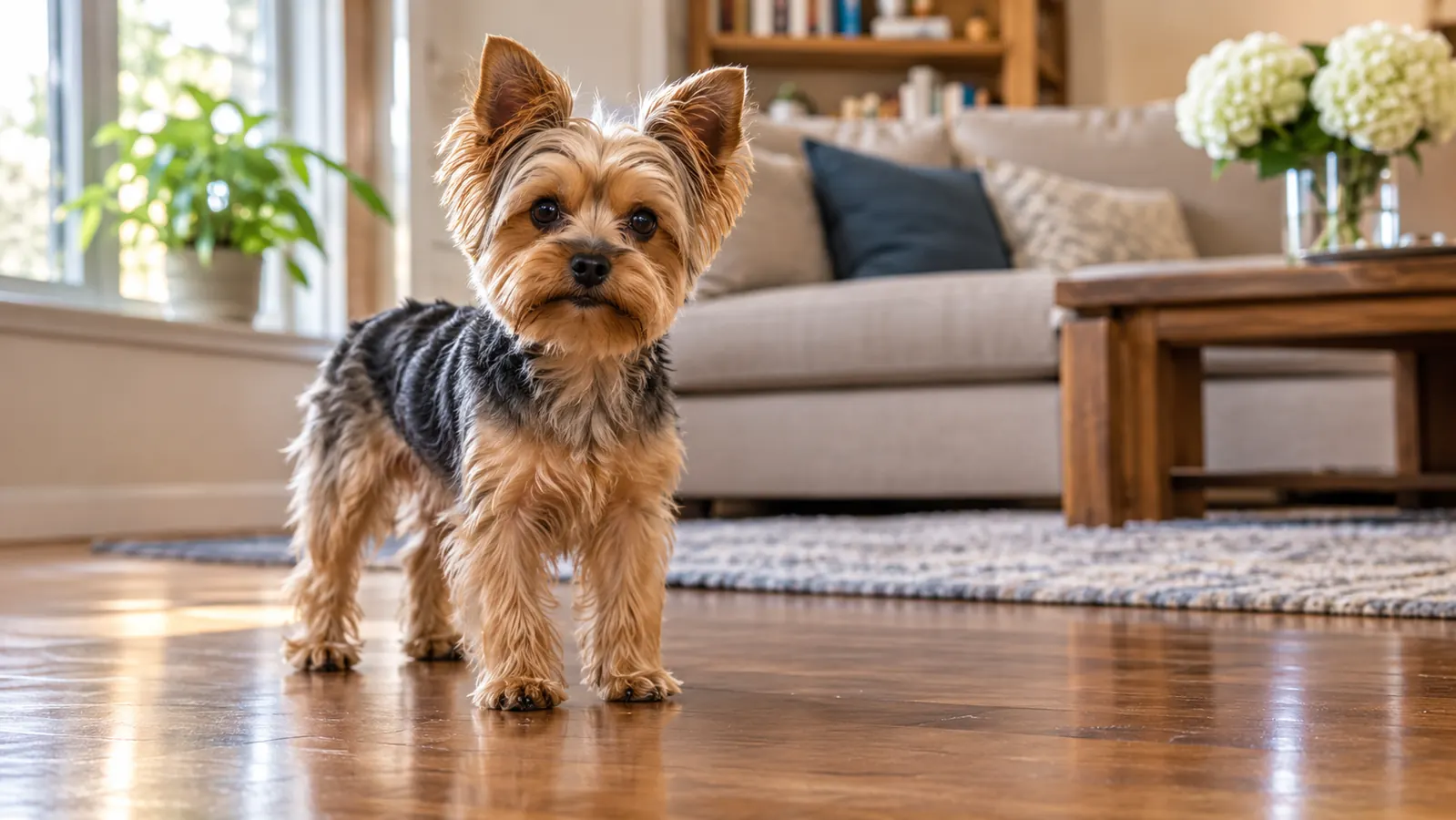
The first time Pepper's back legs slid out from under her, she didn't make a sound. She stood there with her front paws planted and her back end splayed out on the living room floor, waited a beat, then gathered herself up and kept walking like nothing had happened. I noticed. When a dog has a long back and short legs, you find out fast when the floor stops being trustworthy.
I'm Lyle Abernathy, 66, retired from the service desk at a car dealership here in Marietta, Georgia. Pepper is my 11-year-old miniature Dachshund, about 12 pounds, with a long back and hips that stay stiff until about ten in the morning. We live in a one-story brick ranch with hardwood in the living room and three brick steps down to the backyard. What finally worked was dull and cheap: four DOK non-slip socks, sized off a tape measure instead of a guess, and two weeks spent teaching her to wear them before I ever asked her to walk in them.
Before that I tried what people told me to try. I trimmed the fur between her pads. I put a bath mat at the bottom of the steps. I bought a set of rubber toe grips that came off in the yard and were never seen again. None of it was wrong, exactly. None of it fixed the six feet of floor between her bed and the back door, either. I'm not a vet and I won't pretend socks fix a joint. What they fix is the slipping, and the slipping is what turns a stiff morning into a bad week. Here's the order I'd do it in if I were starting over.
Four socks and a tape measure beat every rug I brought home
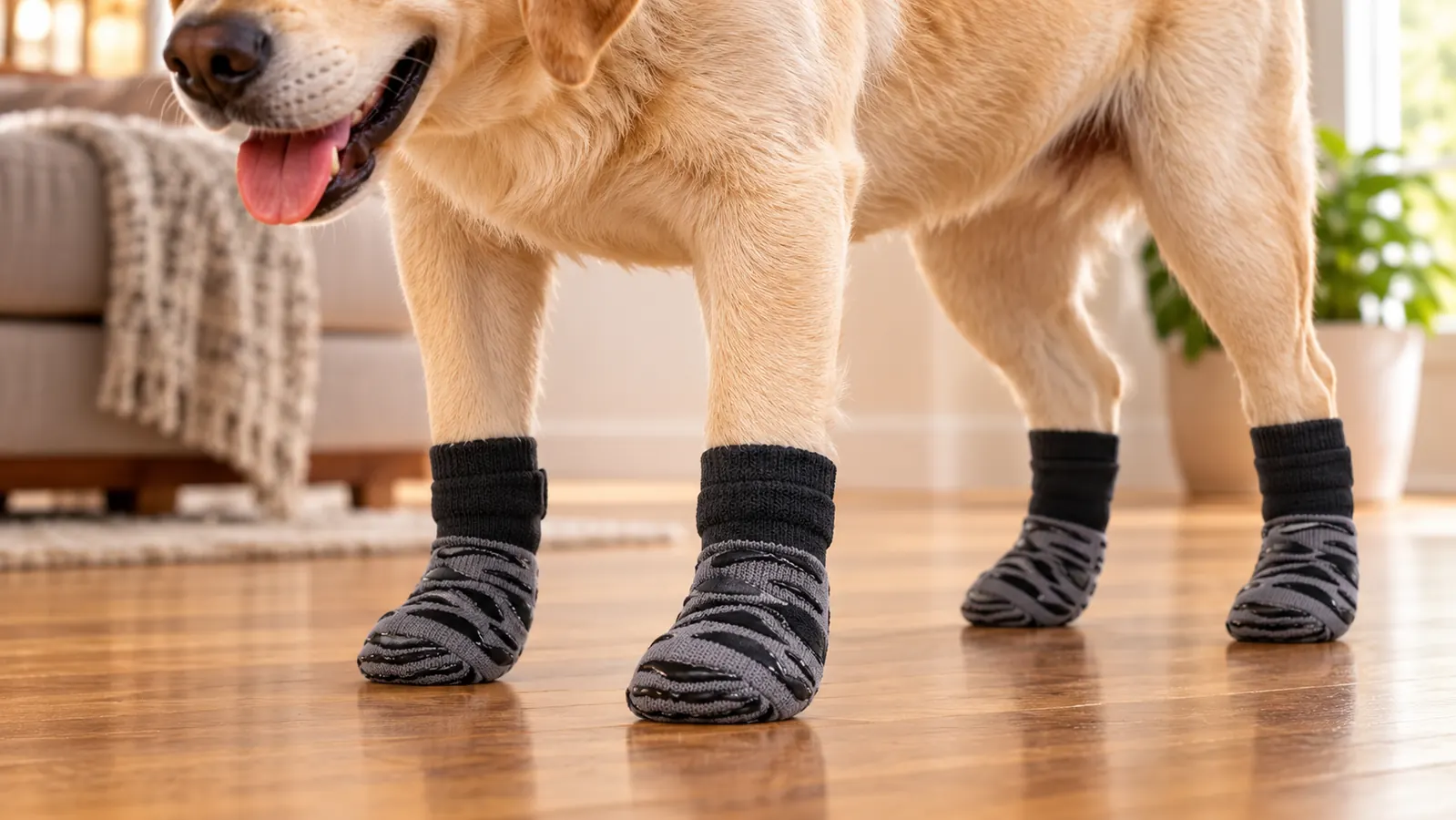
These are the pair that stayed on Pepper's feet through a full walk instead of ending up in the hallway. Measure the paw first, then match your number to the size chart on the listing.
Amazon Check Today's Price on Amazon →Step 1: Measure the Paw Before You Order Anything
Sizing is where this goes wrong for most people, and it isn't their fault. Sock packaging talks in small, medium and large, but a paw doesn't know what size it is. Stand the dog on a sheet of paper, mark the widest point across the pads, then mark from the back of the heel to the tip of the longest nail. Write the number down. You'll want it again in six months and you won't remember it. DOK publishes a paw measurement range for each size on the listing, including the Large at 2.5 to 2.8 inches, so you're matching your number to their number instead of guessing off the word on the bag.
If your dog lands between two sizes, take the smaller one. A sock that's a touch snug stays where you put it. A sock with room to spare rotates on the paw, and a sock that rotates is a sock the dog is going to work off in the hallway before you've finished your coffee. Each set comes with four socks, one per foot, and they're cotton and nylon, which means they go in the washing machine when they get grubby. That matters more than it sounds like it matters. A sock you have to hand wash is a sock that stays in the drawer.
The other thing to check before the first wear is the closure. DOK uses a hook and loop strap that pulls on and fastens across the top of the foot, which is what keeps the sock from sliding down the leg on a dog that moves around a lot. Lay the strap flat before you fasten it. A twisted strap is where a rub starts, and a rub is where the dog decides socks are a bad idea for the rest of his life.
Step 2: Teach the Socks Before You Ask for a Walk
Don't put four socks on a dog and head for the door. That's how you get a dog that plants his feet and refuses to move, and then you're the man standing in the driveway at seven in the morning with a frozen Dachshund in a sock. Start in the evening, after the walks are done and the dog is tired. Put one sock on one front foot, give a small treat, take it off. That's the whole first session. Ninety seconds. Then dinner.
Next day, two socks. The day after that, three. By the fourth or fifth day, all four. The whole time you're just putting them on, feeding a treat, and letting the dog stand there and think about it. When Pepper first got all four on she picked her feet up high like she was marching in a parade, one leg at a time, all the way down the hall. That's normal. It isn't pain. It's a dog feeling something on his feet and not knowing yet what to do about it. Most dogs settle inside ten minutes.
If your dog freezes and won't take a step at all, take two socks off and end the session there. You're building a habit, not winning an argument. A dog that had one good experience with socks on is a whole lot easier to work with on day five than a dog that had one bad one on day two and remembers it.
Step 3: Get the Grip Under the Pad and the Strap Snug
The grip patch goes on the bottom of the foot, under the pads. That sounds too obvious to write down until you've done it half asleep at six in the morning and put a sock on sideways. Feel for the patch with your thumb before you fasten anything. Then run your hand around the top of the sock and smooth out the bunching at the ankle. A bunched sock doesn't sit right, and a sock that doesn't sit right is going to roll.
The strap wants to be snug, not tight. Slide one finger under it. If a finger goes in easy, it's probably going to work its way down during a walk. If you can't get a finger in at all, it's too tight and you'll see a mark on the leg when the sock comes off. Check it again two minutes after the dog starts moving, because the sock settles as the paw spreads out under weight. I check Pepper's straps at the start of every walk the first week, and once mid-walk on the longer one.
This is the part DOK did better than the plain socks I tried before. Their grip is built to keep working even when the sock twists on the paw, which on a small dog with short legs happens more than you'd think. The cheap pairs I had would spin halfway around and suddenly the dog was walking on smooth cotton with nothing under him. With these, a twist is a nuisance. It isn't a fall.
Three slips in one week on the same six feet of floor is not a clumsy dog. That's a floor problem and a joint problem, and both of them are worth fixing.
Step 4: Fix the Floor While the Socks Do Their Job
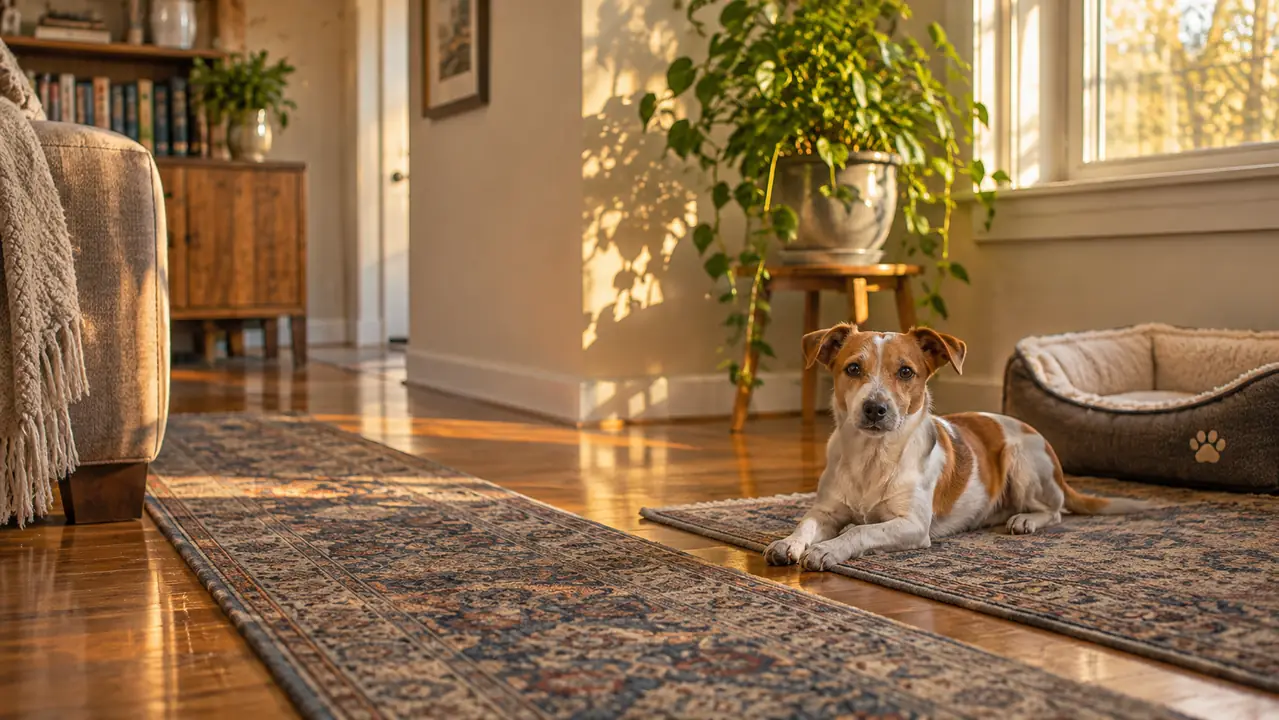
The socks help the dog. They don't change the floor, and the floor is half of this. Walk the route your dog takes twenty times a day and look down at it. For us that's from the dog bed in the corner, across the living room, past the couch, to the back door. That path is where the slipping happens, and it's usually two or three bad spots, not the whole room.
Put something down on the worst of it. A runner along the main path. A mat at the base of the couch. A small rug in front of the door. Then put a gripper pad under the rug, because a rug that slides is just a bigger, softer slip. Our three brick steps down to the yard have never been the problem. The concrete pad at the bottom is, when it's wet, so I wipe Pepper's paws on the way back in and I don't let her take those steps at a run anymore.
Two more floor jobs and then you're finished with this step. Keep the nails short, because a long nail lifts the paw and changes how the pads sit on the floor. And keep the fur between the pads trimmed, either at home or when the groomer has him. That fur is what makes a paw slide on hardwood, and it's the reason a fair number of people think their dog has a balance problem when he doesn't.
Step 5: Write It Down for a Month and Let the Vet Look at the Hips
I keep a small notebook on the kitchen counter. Every morning I write the date, whether Pepper was stiff getting up, whether she slipped at all the day before, and how far we walked. That's it. Four lines. I started because I couldn't answer a simple question: is this getting better, or is it getting worse? A month of four-line entries answers it. A feeling in your gut does not.
Socks handle the floor. They do not handle a joint. If your dog is hesitating at the steps, refusing the couch, or standing with his back legs closer together than they used to be, that's a vet appointment, not a sock problem. Our vet in town looked at Pepper's hips, told me straight what we were dealing with, and gave me a plan to work. The notebook went with me, and it turned a vague "she seems slower" into something he could actually use.
One thing I got wrong for a while. I thought I had to choose between the walks and her comfort, and I started skipping the evening one so she wouldn't have to deal with the floor. That was backwards. The two walks a day are what keep her moving, and once the slipping stopped she was willing to go again. On Sundays the grandchildren come over after church and the house gets loud and busy and there are feet everywhere. That's the day the socks earn their keep.
What Else Helps
A couch ramp is the other thing that changed our week. Pepper used to launch herself at the couch and hope for the best, and that hop is hard on a long back. A short ramp with a carpeted surface cost less than a tank of gas and she uses it now without being asked. If your dog is already hesitant about jumping, this is the cheapest fix on the list.
Weight matters more than most people want to hear. Twelve pounds is about right for Pepper, and our vet told me plainly that every extra pound on a dog that size is a load on those hips. I measure her food with a scoop instead of eyeballing the bowl, and I've cut back on the table scraps June slips her when she thinks I'm not looking.
Warm up slow, too. The first five minutes of the morning walk are the stiffest, so we start on the grass and take it easy before we pick up the pace. Cold muscles on a hard floor is a bad combination, and it's a worse one first thing in the morning.
And know when to stop reading articles like this one. If your dog is dragging a back leg, knuckling over on the top of the foot, or yelping when you pick him up, skip all of it and call your vet today. Socks are a floor fix for a dog who has already been checked. They are not a substitute for a diagnosis, and no pair of socks on the market is going to tell you what's going on inside that hip.
Start with the measurement, not the shopping cart
Measure across the pads, write the number down, and match it to the size chart on the listing. One set covers all four feet and goes in the washing machine when it needs it.
Amazon Check Today's Price on Amazon →