
Pepper is eleven now. Twelve pounds, long back, and hips that need a few minutes to loosen up in the morning. About a year ago he started stopping at the top of the three brick steps down to our backyard. Not refusing to go out. Just stopping. He would stand there, look down at the patio, look back at me, and wait to be carried.
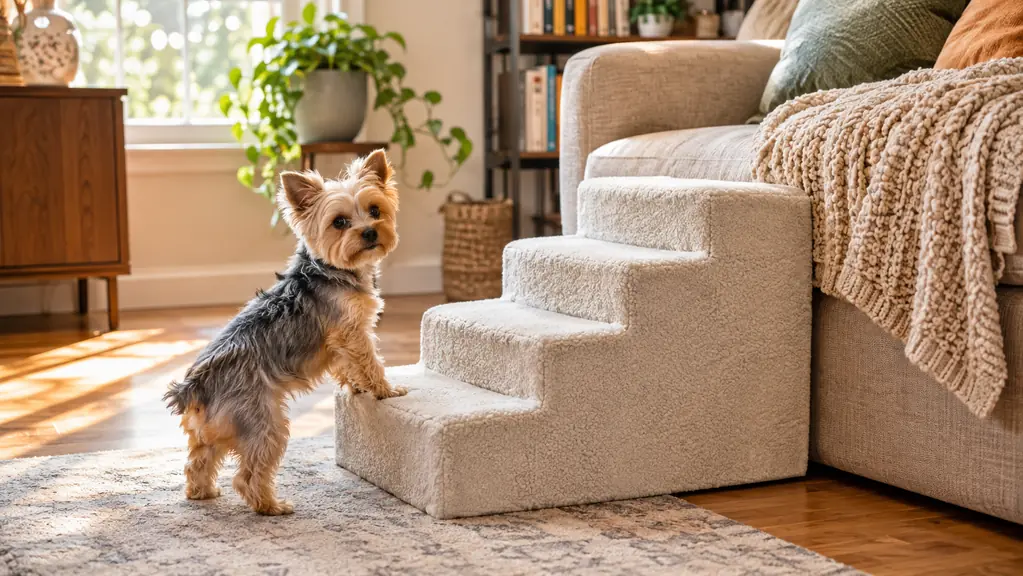
I carried him for a while. Then my own back started talking, and our vet reminded me that hoisting a Dachshund by the middle does his spine no favors either. So I went looking for dog steps. The first set I brought home was a waste of a Saturday. Pepper took one look and walked around it. The set that finally worked, and the one I will refer to through the rest of this piece, is the aodisman four-step pet stairs. It is foam, weighs about 5.8 pounds, and it stands 17.4 inches tall, which lands right at the edge of our couch. It took three weeks of short daily sessions before Pepper climbed it without me saying a word. What follows is the sequence I used, in the order I would run it again.
The four-step set that ended the lifting in this house
Foam, 5.8 pounds, no assembly required. It arrives compressed and expands into its stair shape within 24 to 48 hours, with a non-slip bottom that holds it against the couch instead of skating across the floor.
Amazon Check Today's Price on Amazon →Before Step One: What I Got Wrong the First Time
The first set I bought had two problems, and neither one had anything to do with Pepper. The rise between steps was too steep for legs that are about three inches long, and the surface was hard plastic with no give. His nails clicked on it and skated. A dog that slips once on a set of steps will not give you a second chance for a while. That is why the surface matters more than the height. The aodisman set gives his pads fabric to push against, and four steps across 17.4 inches means no single rise is a stretch.
The other thing I got wrong was speed. I put Pepper in front of the steps with a treat in my hand and expected him to work it out in an afternoon. He is eleven, not two, and he moves like a man who has learned that one bad step costs him a week. So the second time around I slowed everything down and treated it like a job with five stages. Which is what this is.
And one more thing before the steps. Get the dog checked first. If Pepper had a disc problem instead of stiff hips, three weeks of climbing practice would have been the wrong answer entirely. Our vet cleared him, told me the steps were a reasonable idea, and gave me a weight to hold him at. Twelve pounds is where he stays. Do that part first, then read the rest of this.
Step 1: Put the Steps Where the Dog Already Wants to Go
I first set ours beside the couch in the living room, in a spot that photographs nicely and that Pepper had no reason to visit. Nothing happened for four days. Then June asked why I had not put them where he actually gets up. She was right. The couch is his evening spot, right next to where I sit, and the back steps are where he goes out six times a day. Put the steps at the place the dog is already trying to reach and you are most of the way done.
Push the top step tight against the furniture. The instructions that came with ours call for placing it right up against the edge of the bed or couch, and that detail matters more than it sounds. A gap of two inches gives a dog a reason to stop and think, and a thinking dog will ask to be lifted. Ours sits snug against the cushion with the non-slip bottom holding it on the hardwood.
Then leave it there and ignore it for two days. Do not coax, do not point, do not stand there watching with your hands in your pockets. Let the dog sniff it on his own schedule. A new object that gets a big reaction out of you is a new object worth being suspicious of.
Step 2: Let the Foam Finish Expanding Before You Train Anything
The aodisman steps arrive compressed. Ours looked like a flat slab when I got the wrapping off, and the listing says it takes 24 to 48 hours to pop out fully into the stair shape. I did not believe that, so I checked at hour twelve and it was still half formed. Give it two full days in a warm room before you ask a nervous dog to trust it. A step that shifts under a twelve pound dog is a step he will not use twice.
If the steps still feel soft in the middle after two days, give them another day. Ours firmed up noticeably between the first morning and the second. There is no timer to set and nothing to assemble, which is the part I appreciated most. It comes out of the wrapping as one piece and it stays one piece.
While it is still expanding, set it where it is going to live. A couch edge today beats a garage shelf for a week and a move later. Ours has not left the living room since the day it came out of the box.
Step 3: Teach the Bottom Step First, Then Stop for the Day
This is the part most people rush, including me. You are not teaching the dog to climb stairs. You are teaching him that the first step is safe. That is a one step lesson and it takes about ninety seconds a session.
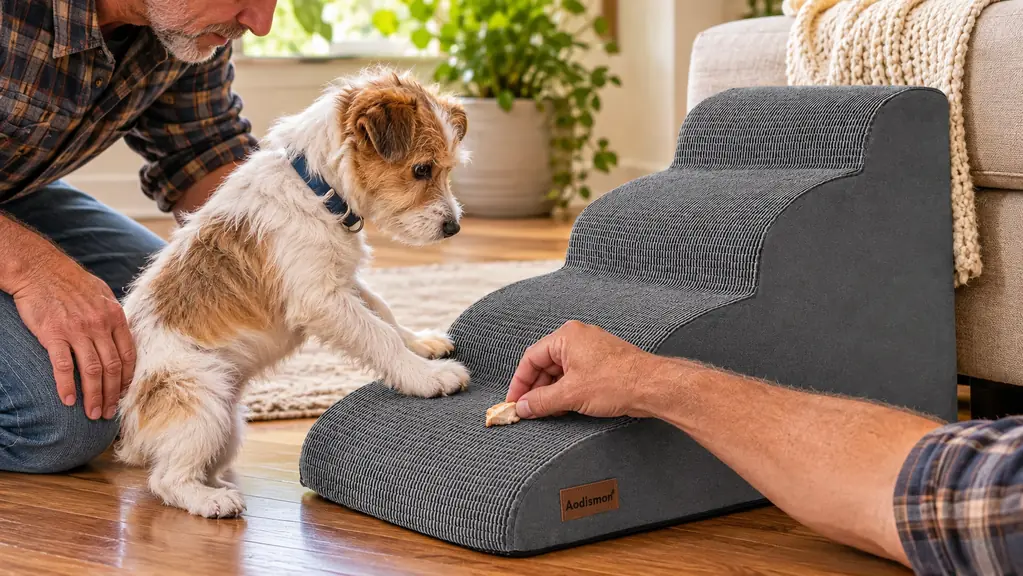
I sat on the floor next to the bottom step with a piece of chicken. Not a bowl and not a pile, one small piece at a time. I let Pepper smell the step, then I set a piece on the first tread and let him take it. That was the whole first session. He got paid for putting his nose near it, and then we quit.
Day two, the treat moves to the second step and his front feet have to come up to reach it. Day three, the back feet. Day four, the top. Some dogs move a step a day. Pepper took six days to get from the first step to the third, and then two more to the top. The pace does not matter. What matters is that every session ends with him winning something.
Step 4: Pay for Progress, Then Fade the Payment
Pepper will work for food, so food is what I used. If your dog will not, use a favorite toy or five seconds of real praise, whichever one he will actually work for. The principle does not change. Something good happens on the steps and nowhere else.
The mistake I made was paying too long. Put a treat on every step for three weeks and you get a dog who stands on the second step waiting for the check. So I paid for the bottom step for two days, then only for the top, then only every other trip. By the end of week three I was paying once a day. By week four I forgot entirely, and Pepper climbed up and lay down without looking back.
One thing that helped more than the treats: I used the same two words every time he made it up. Ours was "up you go." Six weeks later that phrase gets him onto the steps from clear across the room. Pick yours, say it every single time, and do not change it because you got bored with the sound of it.
The first set failed because his nails skated on hard plastic. A dog who slips once will not give you a second chance for a while, and no amount of chicken fixes that.
Step 5: Practice When the Dog Is Fresh, and Quit While It Is Still Easy
Pepper is stiffest in the evening. I learned that the hard way by training him after dinner for a week and getting nowhere. Morning is better, after he has been up and moving for ten minutes, before our first walk. His hips are looser and his head is clearer. That is when we practiced, and that is when it started working.
Two minutes a session. Not ten. A session that ends while the dog still wants more is a session he will show up for tomorrow. A session that ends with you frustrated and him flat on the rug is one you will both remember, and not fondly.
Keep the walks, too. The steps exist so the walks can keep going, not the other way around. Our vet put it plainly once: the goal is not fewer stairs, it is a dog strong enough to keep doing the ones that matter. I think about that every morning at the top of the driveway.
If your dog is already on a joint supplement or pain medication, keep it going through the training. This is not the week to change two things at once. I made that mistake with a different issue years ago and spent a month unable to tell which change had helped. Change the steps, hold everything else steady, and give it three weeks before you judge it.
How Long It Takes, Honestly
Pepper took three weeks to use the steps without a treat in my hand and about five weeks before he chose them over asking to be lifted. That is on the slow end. A younger dog with no hip stiffness will often take to it in three or four days, mostly because he is curious and not careful. An older dog who has already been lifted for a year has learned that waiting works, and unlearning that takes longer than learning the stairs.
The number that matters is not days. It is whether the trend is going the right way. If on Sunday the dog puts one foot on the bottom step without being asked, you are winning, even if he will not go up. Two steps forward and one back is normal, and a bad day after a vet visit or a cold snap is not a failure. Start the next session at the step he was sure of and work forward again.
What Else Helps
Trim the nails. Long nails on a Dachshund change how the foot lands and make a slick surface worse than it needs to be. I do Pepper's every three weeks, and I can tell within a day when I have let it slide.
Keep the path clear. If the steps live in front of the couch, nothing else goes in front of the couch. A dog will take the easy route every time, so the easy route has to be the steps. I moved a footstool out of the living room entirely because Pepper was using it as a shortcut and I could watch him stall halfway.
Get everybody in the house on the same page. June kept lifting Pepper onto the couch for two weeks after he had started climbing on his own, which told him that climbing was optional. Sunday grandchildren are worse about it. Kindly but firmly, ban the lifting unless the dog is actually stuck. Consistency from every human in the house is worth more than any treat in the bag.
When to Call the Vet Instead
If your dog yelps, bunny hops on one back leg, drags a foot, or suddenly stops using the steps after a few good weeks, make the call. That is not a training problem. Pepper refused the steps for four days last spring and I assumed he was being stubborn. Our vet found a flare in his hips and we changed his medication. The steps are a tool. They are not a diagnosis, and when something changes, get it looked at.
Four steps, no assembly, and one less lift a day
The aodisman set has sat in front of our couch on a hardwood floor for the better part of a year, with a twelve pound dog going up and down it several times a day. The foam has held its shape, the non-slip bottom still holds the floor, and it carries a one year warranty.
Amazon Check Today's Price on Amazon →