
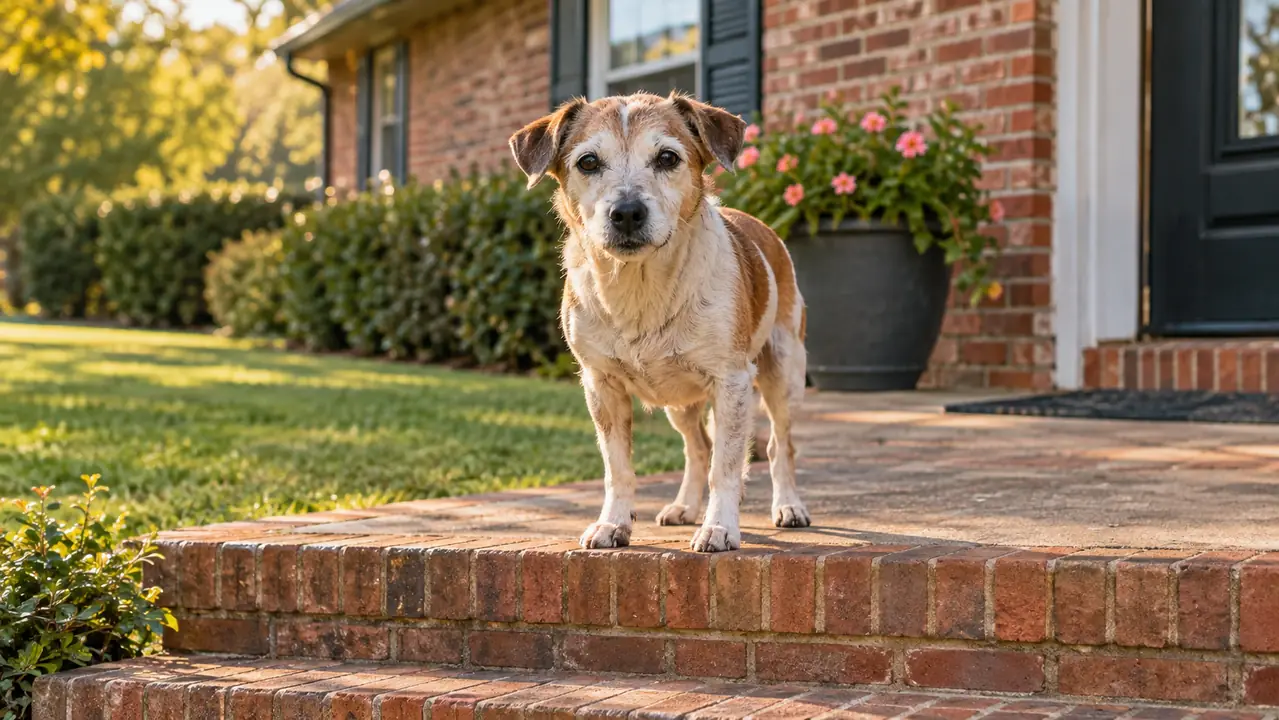
Pepper started balking at the three brick steps off the back of the house sometime last spring. Not refusing, exactly. She would stop at the top, look down at the yard, look back up at me, and wait. She is eleven years old, twelve pounds, a miniature Dachshund with a long back and hips that need a few minutes to loosen up in the morning. For a while I just carried her down. Then I did the arithmetic on what carrying a long-backed dog does to a long back, and I started looking for something better. What I ended up with is the PICK FOR LIFE adjustable dog lift harness, a nylon sling with a padded handle that goes under the hindquarters so you can take some of the weight off the back end while the dog keeps walking on her own front legs.
I am not a trainer and I am not a vet. I am a retired service manager from a car dealership in Marietta, Georgia, and what I know how to do is watch a part under load for a few months and see whether it holds. So that is what this is. Six months, two walks a day, one eleven-year-old Dachshund, plus every trip up onto the couch and every ride in the Buick. I tried the folded towel under the belly first, the way everybody does. It slid forward after four steps and I spent the rest of the walk hitching it back into place.
The Quick Verdict
A simple nylon sling that let me keep walking Pepper twice a day instead of watching her quit the steps. Six months of hard use and the stitching and the handle are intact. It is a helper, not a treatment, and the sizing runs small even for small dogs.
Amazon Check Today's Price →The difference between a dog who takes the steps and a dog who stands at the top of them
This is the sling I reach for by the back door every morning. It weighs less than five ounces, folds flat enough for a jacket pocket, and takes about ten seconds to put on once you have the fit right.
Amazon Check Today's Price on Amazon →How I've Used It
Our house is a one-story brick ranch, and the only real obstacle in it is the three brick steps down to the yard. Indoors it is all hardwood, which is slick under a dog whose nails need trimming more often than I remember to trim them. Pepper's routine is a walk around the block in the morning and another one in the evening, and those two walks are the thing I was most afraid of losing. She is not a dog who enjoys a stroller. She wants her feet on the ground.
So the harness goes on at the top of the steps, stays on through the yard and back up, and comes off in the kitchen. Two walks a day plus the steps, call it four fittings a day, six months, something like seven hundred times I have held that handle. On the longer evening loop I leave it on the whole way but keep the handle slack and let her carry her own weight. It is there for the last hundred yards, when her back end starts to swing a little wide and I can feel the hips getting tired before she will admit it.
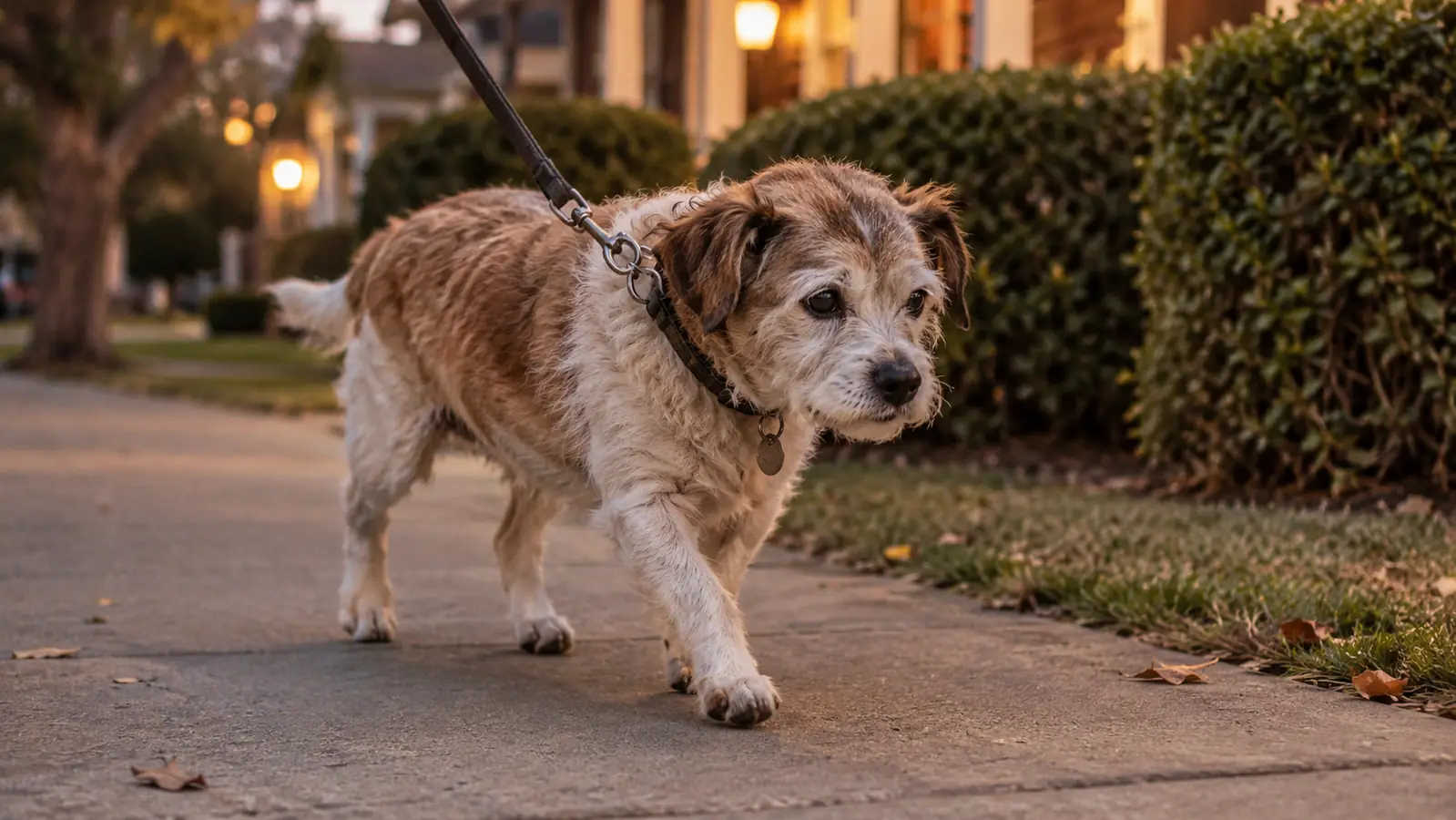
The route matters more than I expected. Our evening loop is a little over half a mile, sidewalk the whole way except for one driveway apron, and there is a stretch a couple of blocks over where the pavement has heaved up in a way that throws her off stride. That used to be where she quit and I carried her the rest of the way home. Now I take up the slack on the handle for about forty feet through that stretch and let it back down on the smooth part. Half a mile, twice a day, and the only places the sling does real work are those forty feet and the three steps. That is worth knowing if you are trying to decide whether you need one. You probably do not need it for the whole walk. You need it for the two or three places where the walk falls apart.
It also goes in the Buick. She cannot make the jump into the back seat anymore, and the handle gives me something to hold while she puts her front feet on the sill and I take the back half. June holds the door and tells me I am doing it wrong. The dog gets in either way.
What the PICK FOR LIFE Harness Actually Is
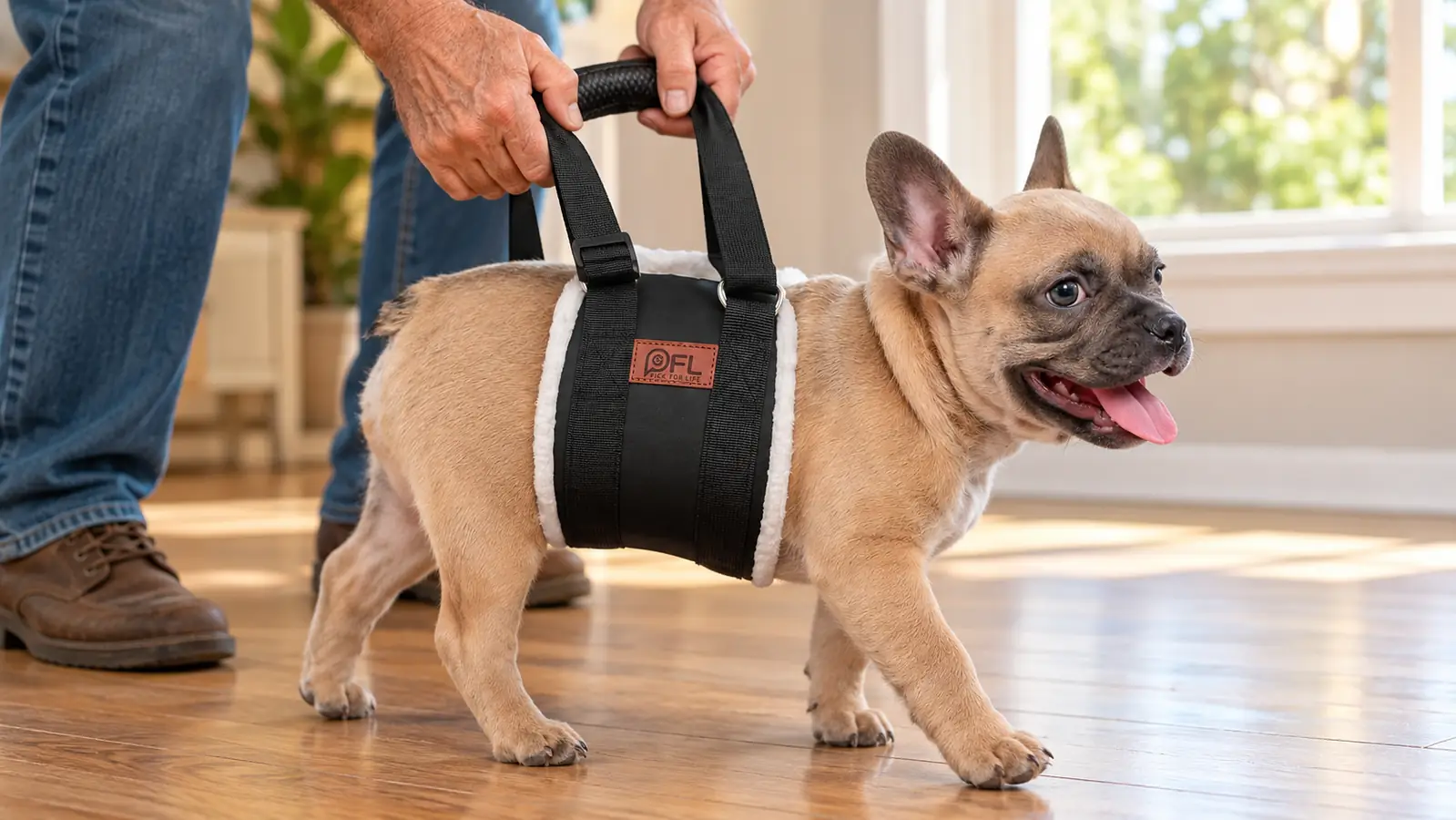
Strip away the language on the listing and it is a nylon sling with a drawstring closure and a padded handle. You fold the sling, work it under the dog's hindquarters, snug the drawstring so it stays where you put it, and lift. The whole thing weighs 4.8 ounces and packs down to about the size of a folded hand towel. It ships with a storage bag and a short user guide, and the guide is worth reading once because the fit is not obvious.
It is sized small and recommended for small dogs, and the listing does not give you a measurement chart worth the name. What I can tell you is that on a twelve-pound dog with a narrow rear, the sling fits with a couple of inches of adjustment left to give. The drawstring is what makes that work. Snugged down, it stays put. Left loose, it walks forward toward the ribcage with every step and you spend the whole walk correcting it, which is the same problem I had with the towel.
The material is machine washable, and after six months I can tell you that matters more than I expected. We walk in Georgia humidity. The sling gets washed every couple of weeks and hung over the back of a kitchen chair to dry, and it has not shrunk, faded, or stiffened up.
The First Two Weeks Were Mostly About Fit
The first fitting was a mess. I had the sling too far forward and too loose, and Pepper took about six steps and then sat down and looked at me like I had lost my mind. The trick, for us, was to fold the sling in half before working it under her, settle it just in front of the hind legs, and snug the drawstring before lifting anything. Lifting first and adjusting second is how you get a dog who does not want to be touched back there.
Third day in, I got it wrong in a way worth repeating. I had the drawstring snug but the sling folded the wrong way, so a seam was riding against the inside of her thigh. She took four steps, stopped, and sat down hard on the sidewalk, and I had to carry her the rest of the way home, which is exactly what I was trying to avoid in the first place. Back at the house I laid the sling on the kitchen counter, looked at how it was folded, and worked it out. The padded face goes against the dog, and the fold needs to run front to back, not side to side. Ten minutes of fiddling on a counter saved me a week of fumbling at the top of the steps.
The other thing I had to learn was how high to hold the handle. Too high and you are lifting the dog off the ground, which is not the point. What you want is enough lift to take maybe a third of the weight, so the hind feet still touch down and still do some of the work. Our vet was clear about that when I asked: keep the legs moving if the legs can still move, because a dog who stops using the back end loses it faster. That one sentence changed how I use the PICK FOR LIFE sling more than the user guide did.
By the end of the second week she was walking to the top of the steps on her own and standing there waiting for me to put it on. That is not affection. That is her telling me she figured out what the thing does. I have not had to argue with her about the steps since.
What Six Months of Twice-Daily Use Did to It
This is the part I actually know something about. I spent thirty years watching parts fail under load, and I expected the handle stitching to be the first thing to go, because that is where the force concentrates. It has not moved. The nylon at the top of the sling shows a slight sheen from being gripped and pulled twice a day, which is normal for a woven material, but there is no fraying, no pulled threads, and no give in the seam when I tug it.
I keep a log. I know how that sounds, but I kept one for thirty years on customer vehicles and it is a hard habit to break. Mine is a spiral notebook on the kitchen counter, and the only thing I write down is the date and whether she took the steps on her own that morning. Out of the last ninety days, she has taken them unassisted on sixty-one. In March it was closer to thirty. I am not going to tell you the sling did that, because our vet changed her medication in April and that is probably most of it. What I will tell you is that the sling is what let her keep practicing while the medication took its time.
The padding in the handle has compressed maybe a quarter of an inch. My hand does not cramp on the walk back up the block, which was not true of the rope loop I tried before this. The drawstring still holds its adjustment. The sling itself has softened up, and softened is better under a dog's belly than stiff. The storage bag is the one piece I never use. It lives in the door pocket of the Buick with a spare leash, and the sling rides in my jacket.
Six months, roughly seven hundred fittings, and the stitching where the handle meets the sling has not moved a fraction. That is most of the review, really.
What It Does Not Do
It does not treat anything. It does not make Pepper's hips less stiff in the morning, and it will not stop whatever is going on back there from getting worse. Our vet handled the diagnosis and the plan, and this sling is one piece of that plan, the piece that lets her keep walking while the rest of it works. If you are looking at a dog who is losing the back end and you have not had that dog seen, put the harness in a drawer and make the appointment first.
It also does nothing for a dog who will not tolerate being handled under the belly. Some dogs will not, and no amount of fit adjustment fixes that. And it will not help a dog who has lost the front end, or one who needs support along the whole body, because it only picks up the rear. On three brick steps, that is enough. In and out of a tall vehicle with a dog who panics, it is not, and I would not pretend otherwise.
I also want to be honest about what getting the fit wrong twice costs you in time. My first order went back, the second one was the keeper, and that whole back and forth ate about three weeks of walking. If I had it to do over I would wrap a cloth tape around the widest part of her rear, write the number on the back of an envelope, and read the listing against it before ordering anything. The size band is wide and vague, and a twelve-pound dog with a narrow rear is a different shape than a twelve-pound dog with a broad one.
The warranty is seven days. I understand why a company selling a nylon sling builds in a narrow window, but I would not count it as protection. What I would count is that mine has held up for six months of daily use, which is a longer test than any warranty covers.
What I Liked
- Padded handle is wide enough that my hand does not cramp on the walk back up the block
- Weighs 4.8 ounces and folds flat, so it rides in a jacket pocket instead of a drawer
- Drawstring closure snugs it down so it stays in front of the hind legs instead of sliding toward the ribs
- Machine washable, and after six months of Georgia humidity it has not stiffened or faded
- Nylon and stitching have held through roughly seven hundred fittings with no fraying at the handle
Where It Falls Short
- Sizing runs small and there is no real measurement chart, so the first order is partly a guess
- Seven-day warranty is short enough that it will not cover much
- Slides forward right away if you fit it loose, which is the mistake most people will make first
- The user guide does not tell you how high to hold the handle, and that is the whole skill
- Does nothing for the front end, and nothing for a dog who will not tolerate handling under the belly
Who This Is For
If you have a small dog, somewhere in that ten to twenty pound range, who is slowing down at the steps, hesitating at the couch, or swinging the back end wide on the second half of a walk, this is the right shape of tool. It is also the right tool for the weeks after a hind-leg injury, when the dog is allowed to walk but not yet to carry the full back end. And it is for the owner who wants the walks to continue more than they want to be seen carrying a dog around, because a dog who keeps using her own legs keeps them longer.
Who Should Skip It
Skip it if your dog is much over twenty pounds, because the sizing is small and the sling will not sit right on a wide rear. Skip it if you have not had the dog looked at, because a harness is a stopgap and a diagnosis is not. Skip it if your dog will not let you near the hindquarters without a fuss, or if the back end is gone to the point that a sling under the hips is not enough support. And skip it if you want something the dog wears all day. This is a tool you put on for the stairs and the walk and take off in the kitchen. Leaving it on a dog who is home alone is how you get a chewed sling and a dog who resents the sight of it.
Pepper still takes those steps herself. That is what six months of this thing bought us.
It will not fix the hips. It will let your dog keep using them, and it will let you keep the two walks a day that made the dog who she is. Ten seconds to put on, machine washable, 4.8 ounces in your pocket.
Amazon Check Today's Price on Amazon →