

Pepper is eleven years old, twelve pounds, and a miniature Dachshund, so her back is long and her hips are stiff until about nine in the morning. I bought the PICK FOR LIFE adjustable dog lift harness expecting a small piece of equipment for a small problem. What I got was a lesson in what a sling can do and, just as useful, in what it cannot. This harness takes weight off the back end of a dog who cannot carry all of hers. It does not walk her for you, it does not fix why her hips are stiff, and it will not fit every small dog straight out of the box. I have had it in daily use long enough to know where it earns its place and where the listing photos flatter it.
What arrives is modest: the sling, a handle, a storage bag, and a user guide. The sling is nylon. The whole thing weighs 4.8 ounces, less than a slice of bread, and it is machine washable, which stops being a small detail the first time you carry a dog's hindquarters through wet grass. The size is Small, listed for small dogs. The closure is a drawstring. There is no frame, no strap around your waist, no wheel, no battery and nothing to charge. It is fabric and a padded handle, and everything it does comes from your hands and your timing.
The Quick Verdict
Does one job honestly: it takes the weight off a small dog's back end at steps, thresholds and the couch. The warranty is short and the fit is unforgiving. Worth it if your vet says the rear end is the problem.
Amazon Check Today's Price →4.8 ounces of help at the three steps she has started to dread
The PICK FOR LIFE lift harness goes under the hindquarters and lets you carry part of the load while your dog keeps using the legs that still work. Check the size chart and today's price before you order, then give your dog a week to get used to it.
Amazon Check Today's Price on Amazon →What Nobody Tells You Before You Buy One
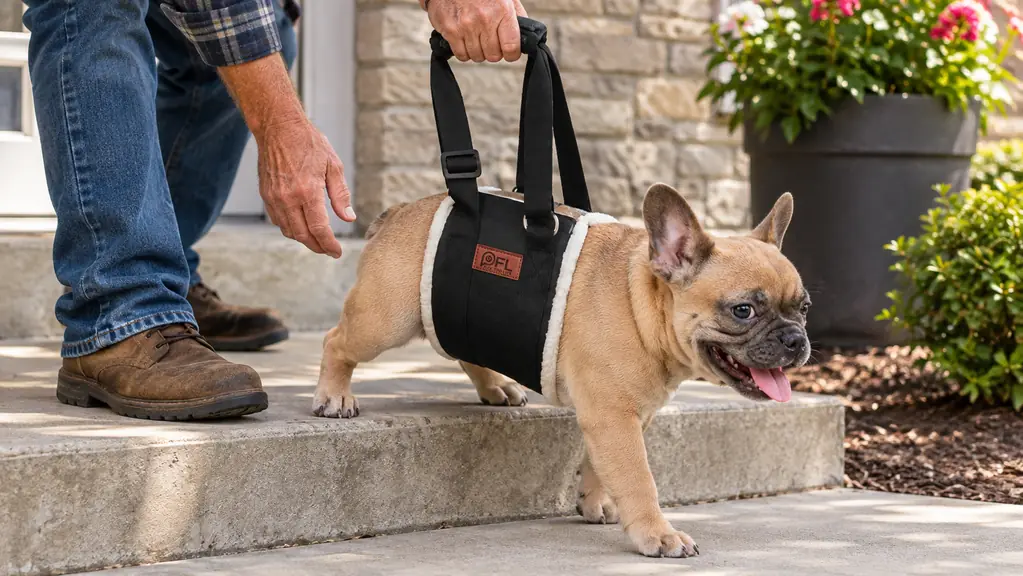
The first thing is that this is a lift aid, not a walking harness. It goes under the hindquarters and you carry part of the load. Your arm is in the conversation the whole time. I had a vague picture of clipping something onto Pepper and letting her do the rest, and that is not how it works. Honestly, that is not a flaw either. It is the design. If you want a device that does the carrying so you do not have to, that is a different piece of equipment with wheels, a frame, and a much bigger footprint in your hallway. What you are buying here is a hand that stays with her.
The second thing is that your dog has a vote. Pepper is even tempered, and she still tucked her tail and sat down flat the first three times I put the sling under her. A dog who is already sore, already confused about why her legs quit on her, is not going to celebrate new equipment. I spent four days letting her wear it in the living room with no lifting at all, then five more days lifting only on the three brick steps out back. If you plan to buy this the week before a trip and have it working by Friday, plan again. Nothing about this goes faster than the dog wants it to go.
The third thing is the warranty. It is seven days. I am not going to dress that up. A week is enough time to know whether the stitching and the sizing are right for your dog, and it is not enough time to know how the sling holds up over months. Keep the packaging for that week, use the thing every single day of that week, and if it is wrong for your dog, say so early. I spent thirty five years as a service manager and I will tell you plainly: the window you get is the window you get, and a short one tells you something about how the maker expects you to use it.
The fourth thing is smaller but practical. It folds into the storage bag and lives in the door pocket of my Buick. I take it to the vet, to my daughter's driveway, to the curb where the sidewalk lifts a half inch at a tree root. Twice now I have been glad of it in a parking lot where the pavement drops off at the ramp. Small dog, small drop, and she looked at it the way she looks at the back steps. Anything you can keep in the car is a thing you actually use, and anything you have to walk back into the house for is a thing you quietly stop using by the second week.
How I've Used It, and What Two Weeks Told Me
I am methodical about equipment. In the shop I never trusted a new tool until I had watched it behave for a few weeks, and I did the same here. Every morning and every evening, Pepper and I go down three brick steps to the backyard and then out to the sidewalk. That is forty two trips a week over the same uneven bricks. Before the sling, she would stop at the top and look at me. After two weeks with my hand under her, she was stepping down without the pause. That was my measurement. Not a before and after video. Just whether she hesitated, and how long.
Where the PICK FOR LIFE sling helps most is not the walk itself. It is the transitions. The three brick steps, the two inch drop from the hardwood onto the living room rug, and the couch, which she had quietly stopped asking to get on. The sling gives her a handrail. She still does the work with her front legs, which is what our vet wants, because the more she uses what she has, the longer she keeps it. What the harness removes is the single moment where she has to guess whether her back end will hold her.
Where it helps least is a long stretch of flat sidewalk. At her own pace on level ground she does not need me, and carrying the handle for a quarter mile gets old for both of us. On those stretches I loop the handle over my wrist, or drop the sling altogether and let her walk. It took about a month to stop treating it as a permanent attachment and start treating it as a tool I bring out for the hard parts. That shift is the whole trick to owning one of these without resenting it.
The sling did not make her walk farther. It made the walk possible on the mornings she would have turned around at the top of the steps.
The Fit Question Nobody Answers Straight
Fit is where this harness lives or dies, and it is the part that reviews gloss over. The size is Small and it is cut for small dogs, but small is not one size. Pepper is twelve pounds with a narrow hind end, and the sling sits where it should, just forward of the tail and under the hips. A dog built like a barrel will fill it differently, and a dog at sixteen or seventeen pounds is at the far edge of what the Small is meant to hold. Measure across your dog's hindquarters and from the tail forward to the middle of the hip. Write the numbers down before you order, not after.
The closure is a drawstring, which is honest and simple and takes two hands. In the house with a cooperative dog that is nothing. On wet grass in the dark with a dog who wants to go back inside, it is a small negotiation. I have gotten quick at it and you will too. But if your hands are arthritic, or if you are holding a leash and a flashlight and a bag at the same time, do the fitting at the kitchen counter first and learn the motions before you need them in the rain.
One more fit note that cost me two weeks. The sling will shift forward if you lift at an angle, and when it does, it stops supporting the hips and starts pressing on the belly. I fixed it by keeping my lifting hand directly above my own hip instead of out in front of me, so the load travels almost straight up. Two weeks of that and it stopped sliding. It was not a defect in the harness. It was a defect in how I was holding it, and I would rather tell you that than have you find it out on a slope.
What I Liked
- Weighs 4.8 ounces, so it folds into the storage bag and lives in the car door
- Nylon and machine washable, which matters on wet mornings
- Takes real weight off the hindquarters at steps, thresholds and the couch
- Padded handle is comfortable even with a twelve pound dog swinging under it
- Adjustable enough to sit correctly on a narrow hind end
- Nothing to charge, nothing to break, no batteries to think about
Where It Falls Short
- Seven day warranty leaves almost no room to judge long term wear
- Drawstring closure needs two hands to seat it properly
- Supports the back end only, with no help at the front
- A determined dog can step out of it on a slope
- Sizing is unforgiving for dogs near the top of the small range
- You have to be there, lifting every time, or it does nothing

Where It Falls Short
The seven day warranty is my first honest complaint. I have used the PICK FOR LIFE sling long enough to see some wear at the seam where the handle meets the body. It is holding fine. But I cannot tell you what it will look like in a year, and neither can anyone else selling one. If long term durability is what you care about most, use it hard during that first week and look at the stitching under a bright light before the window closes. That is the only real durability test available to you, and it is a week long.
The second limit is that it does nothing for the front end. If your dog's problem is a weak front leg or a wrist that folds, a rear sling is the wrong tool and no amount of adjusting changes that. The third is that a determined dog can step out of it. Pepper did exactly once, on a slope, when the neighbor's gate banged. She was fine. But this is support, not restraint, and it should never be your only plan for a dog who bolts.
The fourth limit is the one I want to be clearest about. This harness does not tell you why your dog is slowing down. Stiff hips in an eleven year old Dachshund can be arthritis, it can be a disc, it can be weight, and it can be three other things I am not qualified to sort out. I took Pepper to our vet before I ordered anything, and I would tell any neighbor on my street the same. You buy the harness after the diagnosis, not instead of it.
A smaller thing nobody mentions: you will wash it. Nylon against a dog's underside in a Georgia summer picks up everything, and it dries overnight on the back of a chair. Do not put it away damp. That is how a good four ounce piece of equipment turns into one you stop reaching for, and the storage bag will hold the smell right along with the sling.
Who This Is For
This is for the owner of a small dog who still wants to walk and has started avoiding the parts of the house with steps. The dog who stands at the top of the stairs and waits. The dog who has stopped asking to get on the couch. If your vet has told you the back end is the problem and the front end is sound, this harness is a sensible way to keep her moving, and keeping her moving is most of the battle. It also suits an owner who is willing to be the second half of the machine. You are not buying a solution. You are buying a handle.
It suits a household with a routine, too. Twice a day, same route, same three steps. The sling rewards that kind of consistency. Pepper learned the feel of it in about ten days, and now she leans into my hand before I have the handle up. That did not happen because the harness is clever. It happened because we did the same thing at the same time every day and she is a dog who likes a pattern.
Who Should Skip It
Skip it if you want something that carries the weight for you rather than with you. Skip it if your dog's weakness is in the front legs. Skip it if your dog panics when handled, because a sling under the hindquarters is handling, and a frightened dog on a slope is a fall waiting to happen. And skip it if you are not going to take the dog to a vet first and hear what is actually wrong. A sling under a dog with an undiagnosed disc problem can turn a bad week into a worse one, and no piece of nylon is worth that.
One more group. If your dog sits at the very top of the small range, or is wide through the hips, order expecting that you may be sending it back inside that seven day window. That is not a knock on the harness. It is what happens when one size is asked to cover a range of shapes. Better to know that going in than to be surprised on the day it arrives.
If your vet says it is the back end, this is the handle that helps
The PICK FOR LIFE lift harness weighs 4.8 ounces, washes in the machine, and fits in the car door pocket. Introduce it slowly, watch your dog instead of the product, and check today's price and size before you order.
Amazon Check Today's Price on Amazon →